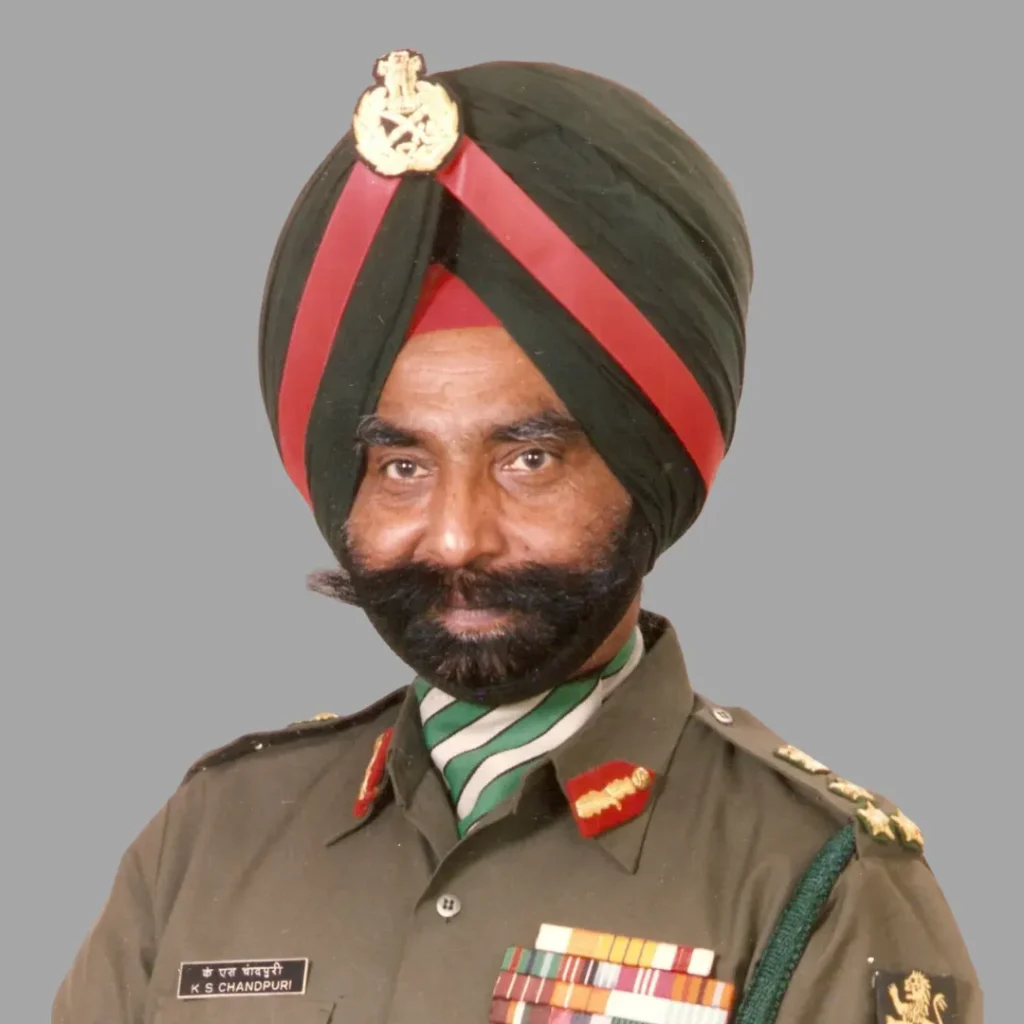
The officer of the Indian Army is among the most honoured military figures in the country’s history and has been known as the brave man who led a successful defence of the Longewala border outpost during the Indo-Pakistani War of 1971. Despite being outnumbered by a Pakistani force that had tanks and heavy weaponry, he helped his small unit to resist attacks all through the night until the arrival of reinforcements from the air. His bravery and excellent leadership skills made the battle a great victory of Indian forces.
His heroic acts allowed him to receive Maha Vir Chakra a highly honourable wartime gallantry award of the second level of the country. Even many years later, Major Kuldip Singh Chandpuri still inspires many people including soldiers, students, and patriots. He symbolizes dedication, selfless devotion, and patriotism that make him a prominent hero of the Indian Army.
Who Was Major Kuldip Singh Chandpuri?
The man who later served as a Brigadier of the Indian Army was Major Kuldip Singh Chandpuri who had been an officer of the 23 Punjab Regiment. He became popular due to his role as a leader of A Company during the memorable Battle of Longewala in December of 1971. In total, he was able to lead a defence of about 120 Indian soldiers who resisted thousands of enemy soldiers supported with tanks and artillery.
Besides that, he dedicated to the service to the country more than three decades of his life.
Major Kuldip Singh Biography at a Glance
| Information | Details |
|---|---|
| Full Name | Brigadier Kuldip Singh Chandpuri |
| Popular Name | Major Kuldip Singh Chandpuri |
| Date of Birth | 22 November 1940 |
| Birthplace | Montgomery, Punjab, British India (now in Pakistan) |
| Nationality | Indian |
| Profession | Indian Army Officer |
| Regiment | 23 Punjab Regiment |
| Rank During Longewala | Major |
| Highest Rank | Brigadier |
| Years of Service | 1963–1996 |
| Famous For | Leadership in the Battle of Longewala |
| Gallantry Award | Maha Vir Chakra |
| Service Award | Vishisht Seva Medal |
| Date of Death | 17 November 2018 |
| Place of Death | Mohali, Punjab, India |
Major Kuldip Singh Chandpuri Age and Date of Birth
Major Kuldip Singh Chandpuri was born on 22 November 1940 in the district of Montgomery in Punjab. Back in those days, Punjab was a province of British India and now lies within the boundaries of Pakistan. After the partition of India in 1947, Major Chandpuri’s family moved to India where he spent all his childhood and youth.
He died on 17 November 2018, just a few days before turning 78 years of age. When he died, Major Kuldip Singh Chandpuri was 77 years old and already took his respectable position amongst India’s best military heroes.
Early Life and Childhood of Major Kuldip Singh
Kuldip Singh Chandpuri was raised in an organized family that placed a high value on patriotism and public service. Since childhood, he was interested in playing games, sports, and leading. Difficulties that his family faced due to the Partition of India affected the development of his character and instilled the feeling of devotion to the Motherland in him.
Being a student, he was diligent, self-confident, and determined. Those characteristics formed the backbone of his subsequent successful military career and were always displayed in difficult conditions.
Major Kuldip Singh Chandpuri Family Background
Major Chandpuri came from a noble Sikh family with military traditions. He became the third generation from his family who joined the army forces. There were many members of his family who had already been serving the Motherland, and therefore, discipline, honesty, and patriotism were highly valued in this family.
His father encouraged him to study and follow the moral standards. Examples of other members of his family who had become army men motivated him to join the Indian Army.
Major Kuldip Singh Chandpuri Education and NCC Experience
Major Kuldip Singh Chandpuri graduated from Government College in Hoshiarpur where he took an active part in the work of the National Cadet Corps (NCC). As a student at that college, he got a lot of military and physical training during NCC training camps.
The excellent results in NCC made him sure that he wanted to become an officer of the Army. Thus, this experience became his entry point in military life and his future army career.
Major Kuldip Singh Chandpuri Height, Weight & Physical Appearance
| Attribute | Details |
|---|---|
| Height | Approximately 5 feet 10 inches (178 cm) |
| Weight | Around 75–80 kg (estimated) |
| Hair Color | Black (later Grey) |
| Eye Color | Dark Brown |
| Body Type | Athletic |
| Personality | Disciplined, Confident, Commanding |
Entrance into the Indian Army
Completing his higher education, along with his excellence in the National Cadet Corps (NCC), Kuldip Singh Chandpuri made his entry into the Indian Army. He was commissioned as an officer in 1963, and joined the 23 Punjab Regiment – one of the most famous infantry regiments in the Army. Right from his early years of service, he distinguished himself by his exemplary discipline, confidence, and leadership qualities that enabled him to command troops under difficult circumstances.
The initial years of his military career were devoted to intensive military training and posting at various operational places across India. As a result of these postings, he developed tactical knowledge, physical fitness, and the necessary confidence to command troops. By the late 1960s, he had won the respect of his fellow officers and soldiers.
Major Kuldip Singh Chandpuri Military Career Prior to the 1971 War
Major Kuldip Singh Chandpuri had already become an accomplished military officer, well before achieving recognition in the Battle of Longewala. His challenging postings in field made him a seasoned and respected officer. The coolness of his decision-making and professional attitude made him an officer whom one could trust with important responsibilities.
Being an infantry officer, Major Chandpuri believed in leading by example, and regularly organized his company in defensive and offensive exercises and instilled discipline and teamwork among his men. It was these preparations that proved vital when the war started in 1971, as his unit was well-prepared mentally and physically for the conflict.
Battle of Longewala – The Whole Story
The Battle of Longewala is considered one of the greatest defensive battles in the history of the Indian Army. On 4-5 December 1971, during the Indo-Pakistani War, Major Kuldip Singh Chandpuri commanded A Company of the 23 Punjab Regiment at the small Longewala border post in Rajasthan. He had approximately 120 soldiers in his company while the Pakistani force had thousands of troops along with dozens of tanks and armored vehicles.
While advancing towards Indian defense, the Major was offered an option to withdraw his company from the strategically important post. However, instead of withdrawal, he decided to defend the post. He ordered his soldiers to defend each position, economize on ammunition, and maintain their composure despite being greatly outnumbered. During the night, Indian defenders used machine guns, recoilless rifles, and well-chosen defensive positions in order to stop the enemy from advancing.
Sandy terrain proved to be an unexpected hindrance to the advance of Pakistani tanks, which resulted in many of them being stuck or advancing very slowly. This situation made the enemy’s armor attack less effective and enabled Indians to resist. As a result, the enemy was unable to capture the post prior to the sunrise.
When day broke, IAF planes conducted repeated air strikes on the exposed Pakistani tanks and other vehicles. The combined efforts of the Army and the Indian Air Force caused the enemy to start to withdraw, and made Longewala a victorious Indian position in this war.
Leadership in the Battle
It was due to Major Chandpuri’s excellent leadership that the Battle of Longewala became a victorious one for the Indians. During the entire night, the Major remained with his soldiers at the front line rather than directing the actions from a safer place. His bravery reassured every man of his company despite the approaching tanks of the enemy.
During the whole night, he kept in touch with his soldiers, encouraging them to economize on ammunition and using all weapons effectively. The Major’s coolness in extremely difficult circumstances prevented any panic and raised the morale of the whole company. Instead of being worried about being greatly outnumbered, he focused on the efficient usage of all available resources.
His actions prove that it does not matter what is the size of the army but the confidence and determination of its commander. This is why this battle is still studied in Indian military academies as one of the most brilliant examples of battlefield leadership.
Role of the Indian Air Force in the Battle
Despite the fact that the Indian Army managed to defend Longewala during the night successfully, the arrival of the Indian Air Force (IAF) in the morning of 5 December 1971 was crucial. The fighter planes conducted continuous attacks on Pakistani tanks, armored vehicles, and supply columns moving on the desert territory.
Due to the fact that the enemy vehicles moved on the open terrain with very little cover, they became easy targets for IAF planes. Several tanks and other vehicles were destroyed and others were left abandoned by fleeing troops. The joint efforts of the Indian Army and the Indian Air Force showed how important the cooperation of the services can be in the war.
The battle is considered one of the finest examples of cooperation of the ground forces and air power in the Indian military history. Without the Army’s successful defense during the night, the Air Force would not have been able to conduct so successful attacks in the morning.
Why the Battle of Longewala Became Historic
The Battle of Longewala is considered one of the most unusual victories in the history of the Indian army because a small group of soldiers managed to protect their position in front of a numerically superior and well-armed adversary. It is known that in such battles as the Battle of Longewala, courage, leadership, proper planning and coordination of efforts outweighed the numerical superiority of the adversary.
Thus, this battle prevented Pakistani troops from further advance into the state of Rajasthan and secured communication routes of the area. The Battle of Longewala encouraged the spirits of the Indian Armed Forces in the 1971 war and became a source of national pride.
Today, the Battlefield of Longewala is examined by military institutions as a case study in the sphere of defensive warfare, battlefield leadership, and coordination between the Army and the Air Force. The battle field is becoming an important site for the visits of the fans of Indian army who want to see for themselves one of the greatest military achievements of the country.
Maha Vir Chakra and Other Honors
For the exceptional courage and self-sacrifice displayed in the Battle of Longewala, Major Kuldip Singh Chandpuri was presented with the MVC (Maha Vir Chakra), the second highest military award for acts of bravery of the India Army. The award emphasized the fearlessness, tactfulness, determination of the officer who defended the Longewala post against superior enemy forces. Thus, his feats became the bright example of military excellence which was used to inspire following generations of the Indian troops.
Apart from the Maha Vir Chakra, Kuldip Singh Chandpuri was rewarded with the Vishisht Seva Medal (VSM) for distinguished services in the Indian Army. During his long military career, he enjoyed numerous praises from military commanders and from the Government of India for his dedication, professionalism, and devotion to the national interests.
Promotions from Major to Brigadier
After the success of the Battle of Longewala, Kuldip Singh Chandpuri continued to serve the Indian Army with his usual dedication and professionalism which brought him recognition as a national hero. As a result of the excellent leadership and numerous years of dedicated service, the officer received a number of promotions in the rank, testifying about the great trust of the Army in him.
After the service in the rank of the Major, the officer was promoted several times and ultimately reached the high rank of the Brigadier until his retirement.
Important Military Appointments
During over thirty years of the military service, Brigadier Chandpuri held several important military positions in different operational and administrative formations of the Indian Army. These duties included command over infantry units, organization of military trainings and handling strategic assignments of the Indian Army.
Thanks to the rich battlefield experience, he became an important advisor to other officers in matters related to military affairs. He was famous for his practical approach to the leadership, strict work discipline and good decision-making skills.
Retirement from the Indian Army
Having served his motherland for over 33 years, Brigadier Kuldip Singh Chandpuri retired from the Indian Army in 1996. His retirement was the culmination of the long military career full of courage, devotion, and distinguished service.
Even after retirement, he continued to cooperate actively with the armed forces by participating in the various military events, veterans’ meetings and educational activities.
Major Kuldip Singh Chandpuri Wife, Kids & Relationships
The personal life of Brigadier Kuldip Singh Chandpuri was always very private and respectable. Though Brigadier Kuldip Singh Chandpuri became one of the most popular war heroes in India, he always preferred to keep his family members out of limelight and concentrate only on his duties as a soldier and then a veteran.
Though not much information about his wife and kids has been revealed in the public domain, people close to him would remember him as an honest, disciplined, humble, and patriotic man who cared for his family.
| Personal Information | Details |
|---|---|
| Marital Status | Married |
| Wife | Name not publicly disclosed |
| Children | Yes (Limited public information available) |
| Residence After Retirement | Mohali, Punjab |
| Lifestyle | Simple, disciplined, and service-oriented |
Qualities and Legacy of the Leader
Bravery, confidence, and sense of responsibility are key traits which defined Brigadier Chandpuri as an experienced leader. In the Battle of Longewala, he proved that the real leader never leaves his comrades in any condition. Not letting fear affect his judgment, Chandpuri used discipline, careful planning, and dedication of his soldiers.
Legacy of Brigadier Chandpuri motivates military officers, cadets, and civilians all around India. Courses about leadership often give examples of this soldier as an excellent demonstration of how confidence, good cooperation, and strategic thinking help to overcome any obstacles. Life of this person is the embodiment of patriotism, self-sacrifice, and loyalty.
Border Movie and the Role of Sunny Deol
Amazing story of the Battle of Longewala became known to millions of people with the help of the movie Border, directed by J. P. Dutta in 1997. In this film, the Indian actor Sunny Deol played Major Kuldip Singh Chandpuri and showed his courage and leadership on the screen.
With the help of his performance, Sunny Deol helped new generations to know about the battle and its participants and learn about self-sacrifices of Indian soldiers. Even though some episodes of the film are exaggerated for the sake of entertainment, the main character was created on the base of the deeds of Major Kuldip Singh Chandpuri. This is one of the most popular war movies of India.
Death of Major Kuldip Singh
Brigadier Kuldip Singh Chandpuri died on 17 November 2018 in Mohali, Punjab because of a long-term illness. He was 77 years old. The death of the famous personality was deeply mourned by numerous military officers, political leaders, war veterans, and ordinary people for whom this brave soldier was an example of a devoted patriot.
His funeral was held with full military honors that prove great respect which he received during his entire life. Even though Brigadier Kuldip Singh Chandpuri is not among us anymore, his bravery during the Battle of Longewala motivates each generation of Indians. His name will forever be connected with the greatest defensive victory of the Indian Army.
Awards & Decorations
| Award / Decoration | Year | Significance |
|---|---|---|
| Maha Vir Chakra (MVC) | 1971 | Awarded for extraordinary gallantry during the Battle of Longewala |
| Vishisht Seva Medal (VSM) | During Service | Awarded for distinguished service of a high order |
| Numerous Military Commendations | Various Years | Recognition for leadership and dedicated military service |
Major Kuldip Singh Career Timeline
| Year | Career Milestone |
|---|---|
| 1940 | Born in Montgomery, Punjab (now in Pakistan) |
| 1947 | Family migrated to India after Partition |
| Early 1960s | Completed graduation and NCC training |
| 1963 | Commissioned into the Indian Army |
| 1971 | Led A Company during the Battle of Longewala |
| 1972 | Received the Maha Vir Chakra |
| Following Years | Promoted through various ranks |
| Reached Brigadier Rank | Senior leadership responsibilities in the Indian Army |
| 1996 | Retired from the Indian Army |
| 2018 | Passed away in Mohali, Punjab |
Major Kuldip Singh Cars Collection and Assets
Brigadier Kuldip Singh Chandpuri lived a simple and disciplined life throughout his military career and after retirement. Unlike many public personalities, he never displayed an interest in luxury cars or extravagant possessions. His life reflected the values of honesty, humility, and service rather than material wealth.
There are no verified public records confirming the ownership of any luxury or premium car collection. Most of his assets were associated with his pension, personal residence, and the benefits earned through his long and distinguished service in the Indian Army.
| Asset | Details |
|---|---|
| Luxury Cars | No verified public information available |
| Residence | Mohali, Punjab, India |
| Main Source of Income | Indian Army Salary (during service) & Pension (after retirement) |
| Lifestyle | Simple, disciplined, and modest |
| Publicly Known Investments | Not disclosed |
Interesting Facts about Major Kuldip Singh Chandpuri
- Brigadier Kuldip Singh Chandpuri is widely remembered as the hero of the Battle of Longewala.
- Kuldip Singh Chandpuri commanded only around 120 Indian soldiers against a much larger Pakistani force supported by tanks.
- Kuldip Singh Chandpuri refused to abandon the Longewala post despite receiving the option to withdraw.
- His courage earned him the prestigious Maha Vir Chakra, India’s second-highest wartime gallantry award.
- Major Kuldip Singh Chandpuri later rose from the rank of Major to Brigadier through years of distinguished service.
- The character played by Sunny Deol in the Bollywood film Border (1997) was inspired by his life.
- Major Kuldip Singh Chandpuri served the Indian Army for more than 33 years before retiring in 1996.
- Major Kuldip Singh believed that a leader should always stand with his soldiers during the most difficult situations.
- His leadership at Longewala is still studied in military institutions as an example of defensive warfare.
- Even after retirement, he actively participated in veterans’ events and inspired young Army aspirants.
FAQs
Who was Major Kuldip Singh Chandpuri?
Major Kuldip Singh Chandpuri was a decorated Indian Army officer who led the successful defence of the Longewala border post during the Indo-Pakistani War of 1971. He later retired as a Brigadier.
Why is Major Kuldip Singh Chandpuri famous?
He is famous for leading approximately 120 Indian soldiers against a much larger Pakistani force during the Battle of Longewala, one of the most celebrated victories in Indian military history.
Which regiment did Major Kuldip Singh Chandpuri belong to?
He served in the 23 Punjab Regiment of the Indian Army.
Which award did Major Kuldip Singh Chandpuri receive?
He received the Maha Vir Chakra for his extraordinary bravery during the 1971 war. He was also awarded the Vishisht Seva Medal for his distinguished military service.
When was Major Kuldip Singh Chandpuri born?
He was born on 22 November 1940 in Montgomery, Punjab, British India (now in Pakistan).
When did Major Kuldip Singh Chandpuri pass away?
He passed away on 17 November 2018 in Mohali, Punjab, at the age of 77.
Who played Major Kuldip Singh Chandpuri in the movie Border?
Bollywood actor Sunny Deol portrayed Major Kuldip Singh Chandpuri in the 1997 war film Border.
What was the significance of the Battle of Longewala?
The Battle of Longewala became a symbol of courage, leadership, and determination because a small Indian force successfully defended its position against a much larger enemy formation until air support arrived.
What was Major Kuldip Singh Chandpuri’s highest military rank?
Although he became famous as Major Chandpuri, he was later promoted to the rank of Brigadier before retiring from the Indian Army.
What leadership qualities made Major Chandpuri exceptional?
His courage, calm decision-making, confidence under pressure, tactical planning, and ability to motivate his soldiers made him one of India’s most respected military leaders.
Conclusion
Brigadier Kuldip Singh Chandpuri’s life is a remarkable story of courage, leadership, and unwavering patriotism. His fearless command during the Battle of Longewala transformed a small defensive position into one of the greatest victories in the history of the Indian Army. By choosing to stand and fight against overwhelming odds, he demonstrated that determination, discipline, and strong leadership can overcome even the toughest challenges.
Beyond his battlefield achievements, Brigadier Chandpuri dedicated more than three decades to serving the nation with honor and integrity. His military career, distinguished awards, and lasting influence continue to inspire soldiers, students, and citizens across India. His legacy remains a shining example of selfless service, and his name will forever be remembered among the greatest heroes of the Indian Armed Forces.
Also, Read About: Major Somnath Sharma || Major Anuj Sood || Major Mukund Varadarajan || Major Sandeep Unnikrishnan Wife || Major Rishabh Singh Sambyal