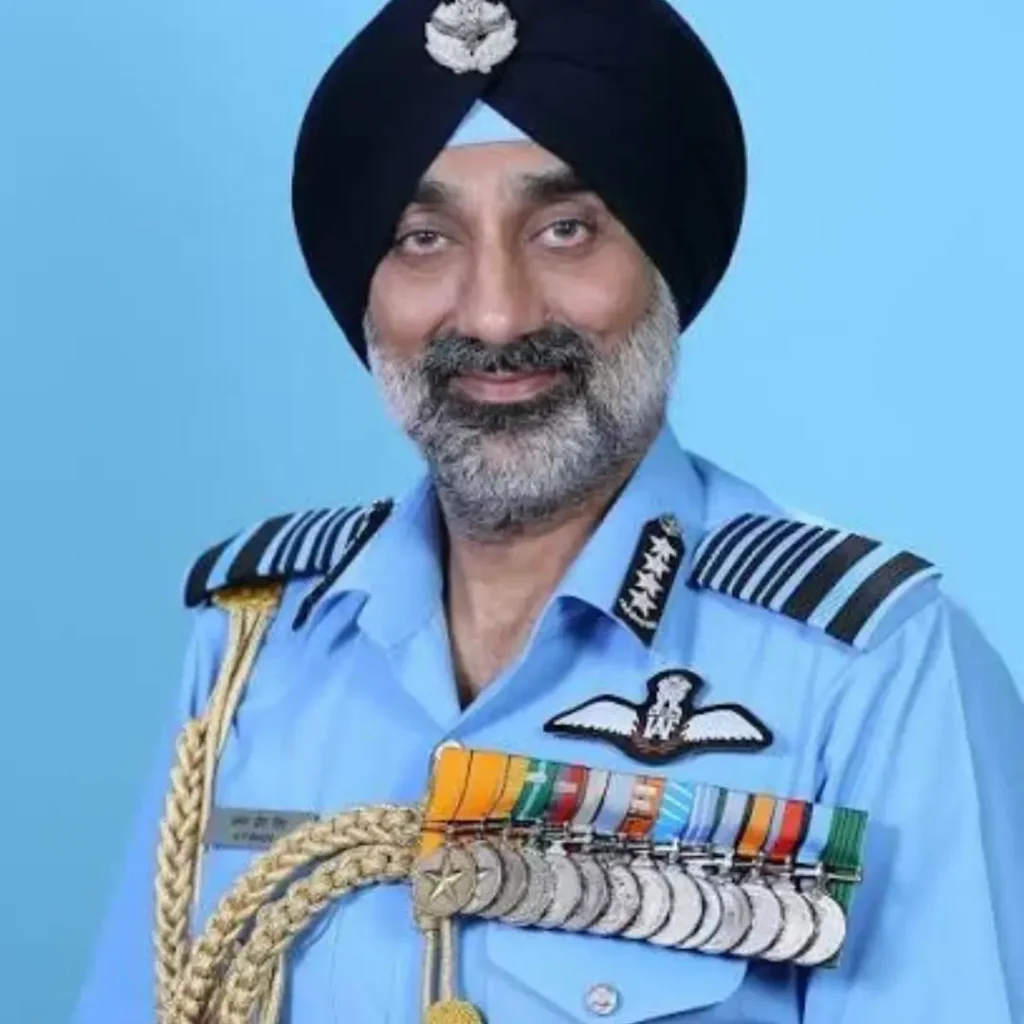
Air Chief Marshal Amar Preet Singh is a distinguished Indian Air Force officer known for his extensive flying experience, leadership responsibilities, and contributions to India’s indigenous fighter aircraft programme. He became the 28th Chief of the Air Staff of the Indian Air Force on 30 September 2024, after a military career spanning nearly four decades. His professional journey includes operational fighter squadron command, flight testing, aircraft modernisation, and senior command appointments.
Born on 27 October 1964, Amar Preet Singh developed his career through military education, specialised aviation training, and a range of operational and technical assignments. As a Qualified Flying Instructor and Experimental Test Pilot, he accumulated more than 5,000 hours of flying experience on different fixed-wing and rotary-wing aircraft. His work on the Tejas Light Combat Aircraft programme and the MiG-29 upgrade project forms an important part of his professional biography.
This detailed article covers Air Chief Marshal Amar Preet Singh’s age, birth details, family background, education, military career, major achievements, awards, leadership responsibilities, and final flying sortie in 2026.
Who Is Air Chief Marshal Amar Preet Singh?
Air Chief Marshal Amar Preet Singh, also known as AP Singh, is a senior Indian military officer who served as the Chief of the Air Staff, the professional head of the Indian Air Force. Commissioned into the fighter stream on 21 December 1984, he built a career combining operational flying, instructor duties, aircraft testing, project management, and strategic leadership.
Before becoming Air Chief, he served as Vice Chief of the Air Staff and Air Officer Commanding-in-Chief of Central Air Command. His earlier appointments included Air Defence Commander at South Western Air Command and Senior Air Staff Officer at Eastern Air Command.
His aviation background distinguishes his career. Beyond flying operational aircraft, he worked on the technical evaluation and development of military aviation systems. These responsibilities gave him experience in both the practical demands of fighter operations and the engineering challenges involved in introducing and upgrading aircraft.
In October 2026, as his tenure approached its conclusion, Singh completed his final flying sortie in an HJT-16 Kiran Mk-1 trainer aircraft at the Air Force Academy in Dundigal, Telangana. He flew with his first flying instructor, Wing Commander V. S. Kochar (Retd), reconnecting the final chapter of his flying career with its beginnings in 1984.
Air Chief Marshal Amar Preet Singh Biography Overview
| Particular | Details |
|---|---|
| Full Name | Amar Preet Singh |
| Popular Name | AP Singh |
| Nationality | Indian |
| Profession | Military officer and fighter pilot |
| Date of Birth | 27 October 1964 |
| Age | 61 years as of 24 October 2026 |
| Birthplace | Delhi, India |
| Service | Indian Air Force |
| Commissioning Date | 21 December 1984 |
| Highest Rank Held | Air Chief Marshal |
| Major Appointment | 28th Chief of the Air Staff |
| Assumed Office as Air Chief | 30 September 2024 |
| Military Education | National Defence Academy, Defence Services Staff College, National Defence College |
| Professional Qualifications | Qualified Flying Instructor and Experimental Test Pilot |
| Flying Experience | More than 5,000 hours |
| Major Technical Assignment | MiG-29 Upgrade Project Management Team |
| Aircraft Development Role | Flight testing of the Tejas Light Combat Aircraft |
| Major Awards | Param Vishisht Seva Medal, Ati Vishisht Seva Medal |
| Wife | Sarita Singh, as reported in biographical profiles |
| Retirement from Air Chief’s Office | Scheduled for 31 October 2026 |
Air Chief Marshal Amar Preet Singh Age and Birth Details
Air Chief Marshal Amar Preet Singh was born on 27 October 1964 in Delhi, India. As of 24 October 2026, he is 61 years old and is approaching his 62nd birthday. His birth year places his early adulthood during a period when the Indian Air Force continued to expand its operational capabilities and develop specialised aviation training.
His entry into the fighter stream in December 1984 marked the beginning of a professional life centred on aviation, military discipline, and national defence. The decades that followed brought him from the training environment to operational squadrons, aircraft testing assignments, senior command positions, and ultimately the highest professional appointment in the Indian Air Force.
His career demonstrates how a military officer can progress through a combination of flying ability, technical knowledge, leadership responsibilities, and institutional experience. His advancement was not limited to cockpit duties; it also involved managing projects, supporting aircraft development, and overseeing major Air Force formations.
Early Life and Childhood
Amar Preet Singh was born in Delhi, a major administrative and educational centre in India. However, detailed information about his childhood, school years, early family circumstances, and personal experiences before joining military training is not widely documented in official public biographies.
It is therefore more accurate to distinguish between confirmed career facts and assumptions about his upbringing. His eventual selection for military aviation and his progression into specialised flying roles demonstrate a long commitment to professional training and service, but specific stories about his childhood should not be presented as established facts without reliable confirmation.
His formal journey toward an aviation career became clearer when he entered the National Defence Academy system and subsequently trained for the Indian Air Force. These institutions provide demanding academic, physical, and leadership preparation for future officers. Singh’s subsequent qualifications as a flying instructor and experimental test pilot reflect the additional specialist training he undertook after his initial military education.
His life story is especially relevant to readers interested in military careers because it illustrates the importance of long-term professional development. Reaching senior command in the Air Force requires much more than learning to operate an aircraft; it involves decision-making, technical understanding, operational judgement, and the ability to lead personnel across complex organisations.
Family Background
Air Chief Marshal Amar Preet Singh’s family background is a subject of interest among readers who want to understand the personal side of his life. However, detailed information about his parents, siblings, and extended family is not comprehensively available in official military biographies.
His professional record provides extensive information about his service, education, and appointments, while his family has largely remained outside the public spotlight. This distinction is important when writing about a senior military officer because private family information should not be confused with verified service details.
Singh’s career required frequent changes in responsibilities, demanding training schedules, operational commitments, and postings at different military establishments. A career of this nature also requires family members to adapt to the demands of military life, although the personal details of how his family managed these responsibilities are not extensively documented.
His public identity is primarily associated with professional service, aviation, and leadership within the Indian Air Force.
Education and Military Training
Education and specialised training played a central role in Amar Preet Singh’s professional development. His academic and military qualifications prepared him for operational flying, command responsibilities, and technical work involving advanced military aircraft.
School Education
Singh attended S.B.M. School in Delhi, according to biographical accounts. His school education preceded his entry into the military training system, where he pursued the demanding preparation required for a career as an Air Force officer.
National Defence Academy
The National Defence Academy (NDA), located at Khadakwasla near Pune, provides joint training for future officers of India’s armed forces. Singh became an alumnus of the academy and was associated with its 65th course. His training there formed an important foundation for his subsequent career in the fighter stream.
The NDA develops leadership, physical fitness, academic knowledge, teamwork, and military discipline. These qualities are particularly relevant to fighter pilots, whose responsibilities involve rapid decisions, coordination with other personnel, and the ability to perform under pressure.
Air Force Academy
After his initial military education, Singh trained at the Air Force Academy in Dundigal, Telangana. The academy prepares officer cadets for commissioned service in the Indian Air Force and provides professional flying instruction.
His first flying sortie took place on 28 January 1984 in an HJT-16 Kiran Mk-1 trainer aircraft. This early experience later became particularly significant when he returned to the same aircraft type for his final flying sortie in October 2026.
Defence Services Staff College
The Defence Services Staff College in Wellington, Tamil Nadu, provides advanced staff training to officers preparing for higher responsibilities. Such training develops the ability to plan operations, coordinate military resources, and understand broader defence requirements.
National Defence College
Singh also attended the National Defence College in New Delhi. The institution focuses on national security, strategic affairs, defence management, and higher-level leadership. Its programmes help prepare experienced officers for responsibilities that extend beyond individual units or aircraft.
Together, these institutions contributed to the academic, operational, and strategic foundation of his career.
Air Chief Marshal Amar Preet Singh Height and Physical Appearance
Air Chief Marshal Amar Preet Singh’s exact height and weight are not consistently established in official public biographies. For that reason, assigning him a specific height or weight without reliable confirmation would be misleading.
As a senior fighter pilot, he worked in a profession that places substantial emphasis on physical fitness, alertness, and the ability to meet demanding aviation standards. Fighter aviation requires pilots to maintain concentration, respond quickly to changing situations, and operate effectively within a disciplined training environment.
Singh has also been described in professional profiles as someone who enjoys physical fitness, long-distance running, and squash. These interests are consistent with the importance of fitness in military life, although personal routines can change over time.
His professional identity is defined primarily by his aviation qualifications, flying experience, command appointments, and service record rather than publicly documented body measurements.
Entry into the Indian Air Force
Amar Preet Singh was commissioned into the fighter stream of the Indian Air Force on 21 December 1984. This date marked the beginning of his formal career as a military officer and fighter pilot.
The fighter stream involves demanding technical and operational training. Pilots must learn aircraft handling, navigation, tactical procedures, mission planning, communication, and emergency responses. As they progress, they may receive specialised training for particular aircraft and operational responsibilities.
Singh’s career subsequently developed across several areas of aviation. He served in operational flying appointments, commanded a fighter squadron and a frontline air base, worked as an instructor, and took on experimental flight-testing responsibilities.
His progression also involved senior staff assignments, where the focus extends from individual flying duties to operational planning, personnel management, and the coordination of resources across larger military formations.
The combination of flying, technical work, instruction, and command helped prepare him for increasingly senior responsibilities within the Indian Air Force.
Military Career and Professional Journey
Air Chief Marshal Amar Preet Singh’s military career spans more than four decades, from his commissioning in 1984 to his scheduled retirement in October 2026. During this period, he held command, staff, instructional, technical, and foreign appointments.
Operational Fighter Squadron Command
One of his important responsibilities was commanding an operational fighter squadron. A squadron commander oversees personnel, operational readiness, training, aircraft availability, and mission-related responsibilities.
The position requires a combination of flying knowledge, organisational ability, and sound judgement. The commander must ensure that pilots and support teams are prepared to perform assigned duties while maintaining operational discipline and safety standards.
Singh also commanded a frontline air base, gaining experience in the wider management of an operational Air Force establishment.
Air Defence Responsibilities
Singh served as Air Defence Commander at South Western Air Command. Air defence involves monitoring potential aerial threats, coordinating surveillance and response systems, and supporting the protection of national airspace.
Such a position requires coordination between aircraft, radar networks, command centres, and operational personnel. It also involves strategic planning and the ability to make decisions within complex and rapidly changing situations.
Senior Air Staff Officer
He later served as Senior Air Staff Officer at Eastern Air Command. This appointment involved senior-level staff responsibilities within one of the Air Force’s operational commands.
Staff appointments are important because they connect operational requirements with planning, administration, training, and resource management. Officers in such roles help ensure that the command can fulfil its responsibilities effectively.
Air Officer Commanding-in-Chief, Central Air Command
Before becoming Vice Chief of the Air Staff, Singh served as Air Officer Commanding-in-Chief of Central Air Command. This was a major leadership appointment involving responsibility for the command’s operational and administrative activities.
The role provided experience in overseeing a large military formation, coordinating subordinate establishments, and implementing Air Force priorities.
His subsequent appointment as Vice Chief of the Air Staff in February 2023 brought him into the senior leadership structure at Air Headquarters. He then assumed the office of Chief of the Air Staff on 30 September 2024.
Career Timeline and Important Appointments
| Year or Date | Career Milestone |
|---|---|
| 27 October 1964 | Born in Delhi |
| 28 January 1984 | Undertook his first flying sortie in an HJT-16 Kiran trainer |
| 21 December 1984 | Commissioned into the fighter stream of the Indian Air Force |
| 2014 | Attended the National Defence College during his senior career, as indicated by service records |
| Before February 2023 | Served in several operational, instructional, technical, and command appointments |
| February 2023 | Became Vice Chief of the Air Staff |
| 2023 | Received the Param Vishisht Seva Medal |
| 30 September 2024 | Assumed office as the 28th Chief of the Air Staff |
| 12 October 2026 | Completed his final fighter-jet sortie aboard the indigenous Tejas |
| 20 October 2026 | Completed his final flying sortie in uniform aboard the HJT-16 Kiran Mk-1 |
| 31 October 2026 | Scheduled date of superannuation from the office of Chief of the Air Staff |
Experience as a Fighter Pilot
Fighter aviation has been a central part of Amar Preet Singh’s professional identity since his commissioning in 1984. His experience includes operational squadron command, flying instruction, aircraft testing, and senior operational responsibilities.
A fighter pilot’s work involves much more than controlling an aircraft. It includes mission preparation, understanding aircraft systems, interpreting tactical information, communicating with other aircraft and ground personnel, and responding to unexpected situations.
Singh’s command of an operational fighter squadron gave him direct responsibility for readiness and operational performance. His subsequent assignments expanded that experience into air defence, command management, and strategic planning.
Over his career, he accumulated more than 5,000 hours of flying experience on a variety of fixed-wing and rotary-wing aircraft. This extensive experience supported his later work as a flying instructor and experimental test pilot.
His career also illustrates the different professional paths available to experienced military pilots. Some specialise primarily in operational flying, while others combine flying with instruction, testing, project management, and senior leadership.
Experience as a Qualified Flying Instructor
A Qualified Flying Instructor (QFI) is trained to teach and assess pilots. The role involves helping trainees develop the technical ability, judgement, discipline, and situational awareness needed for safe and effective flying.
As a qualified instructor, Singh possessed specialist knowledge beyond the operation of aircraft. Flying instruction requires the ability to explain complex procedures, identify mistakes, evaluate performance, and help trainees improve through structured practice.
In military aviation, instructors play an important role in developing future generations of pilots. Their responsibilities include maintaining training standards and ensuring that trainees understand the procedures required for different flying situations.
Singh’s final sortie in October 2026 carried particular significance because he flew with his first flying instructor, Wing Commander V. S. Kochar (Retd). The flight connected his later achievements with the training experience that began at the Air Force Academy in 1984.
Role as an Experimental Test Pilot
An Experimental Test Pilot evaluates aircraft and aviation systems during development, modification, or testing. The role differs from routine operational flying because it may involve examining aircraft performance, handling characteristics, and system behaviour under carefully planned test conditions.
Test pilots work with engineers, designers, flight-test specialists, and other technical personnel. Their observations help determine whether an aircraft meets required performance and safety criteria.
Singh’s qualification as an Experimental Test Pilot led to important responsibilities in India’s aircraft development and modernisation programmes. His work included leadership of the MiG-29 Upgrade Project Management Team in Moscow and serving as Project Director (Flight Test) at the National Flight Test Centre.
These appointments demonstrate the technical dimension of his military career. They required him to understand not only the demands placed on pilots but also the engineering and testing processes involved in evaluating complex military aircraft.
Experimental test flying is a specialised field in which accuracy, preparation, disciplined execution, and careful assessment are essential. Singh’s experience in this area formed an important part of his professional background before his rise to the highest leadership position in the Air Force.
Contribution to the Tejas Fighter Aircraft Programme
The Tejas Light Combat Aircraft is an indigenous Indian fighter aircraft developed as part of the country’s broader effort to strengthen domestic aerospace capability. Its development involved extensive engineering work, flight testing, evaluation, and the gradual refinement of aircraft systems.
Amar Preet Singh served as Project Director (Flight Test) at the National Flight Test Centre, where he was tasked with flight testing the Tejas aircraft.
Flight testing is a critical stage in aircraft development. It helps specialists evaluate performance, handling characteristics, system integration, and compliance with design requirements. Test pilots provide direct observations that support engineering assessment and the resolution of technical issues.
Singh’s involvement placed him at the intersection of operational flying and indigenous aircraft development. His experience as a fighter pilot helped him understand the practical needs of the people who would eventually operate the aircraft, while his test-pilot training supported the disciplined evaluation of its performance.
His later final fighter sortie aboard Tejas in October 2026 added a personal dimension to this professional association. The flight took place during Exercise Tarang Shakti at Jodhpur Air Force Station on 12 October, shortly before his final sortie in the Kiran trainer.
His work on Tejas forms an important part of his biography because it connects his individual flying career with India’s continuing efforts to develop and evaluate domestically produced military aircraft.
Work on the MiG-29 Upgrade Programme
Another significant assignment in Singh’s career was leading the MiG-29 Upgrade Project Management Team in Moscow, Russia. This responsibility involved the modernisation programme for the MiG-29 fighter aircraft operated by the Indian Air Force.
Aircraft modernisation allows an existing platform to remain useful by upgrading selected systems and capabilities. Depending on the programme, such work can involve avionics, mission systems, navigation equipment, cockpit interfaces, and other components.
The MiG-29 upgrade project required coordination between technical specialists and programme personnel. Project management in this environment involves balancing operational needs, engineering requirements, testing schedules, and implementation considerations.
Singh’s role reflected the value of combining flying expertise with technical understanding. As an Experimental Test Pilot, he had experience evaluating aircraft, while his project-management responsibilities required coordination across a broader technical programme.
The assignment in Moscow also represented an international dimension of his service. His career included foreign appointments as well as operational and staff duties within India, giving him exposure to different working environments and collaborative defence projects.
Major Achievements and Career Milestones
Air Chief Marshal Amar Preet Singh’s professional achievements cover operational command, aviation instruction, experimental testing, aircraft modernisation, and senior Air Force leadership.
One major achievement was his progression from a commissioned fighter pilot to the Chief of the Air Staff. This career path required decades of training, experience, and increasingly complex responsibilities.
Another significant milestone was his contribution to the Tejas flight-testing programme. His work at the National Flight Test Centre connected his aviation background with the evaluation of an indigenous fighter aircraft.
His leadership of the MiG-29 Upgrade Project Management Team in Moscow demonstrated experience in aircraft modernisation and technical project coordination. These responsibilities complemented his operational experience as a fighter squadron commander and air base commander.
He also held senior appointments in air defence and command administration before becoming Vice Chief of the Air Staff in February 2023. His appointment as Air Chief on 30 September 2024 marked the culmination of these varied professional experiences.
A further milestone came in October 2026, when he completed his final flying sorties in Tejas and Kiran aircraft. These flights symbolised the conclusion of his active flying career in uniform after more than four decades associated with military aviation.
Air Chief Marshal Amar Preet Singh as Chief of the Air Staff
The Chief of the Air Staff is the professional head of the Indian Air Force. The appointment involves overseeing the force’s operational preparedness, training, personnel, capability development, and long-term modernisation priorities.
Amar Preet Singh assumed this responsibility on 30 September 2024, succeeding Air Chief Marshal Vivek Ram Chaudhari. Before his appointment, Singh served as Vice Chief of the Air Staff, a position he had held since February 2023.
His background in fighter operations and experimental flight testing provided experience relevant to the Air Force’s operational and technical requirements. His previous command appointments also gave him familiarity with the administration of large military formations.
The Chief of the Air Staff works within India’s broader defence leadership structure and is responsible for the professional direction of the Air Force. The role includes balancing immediate operational requirements with longer-term priorities such as aircraft modernisation, training, technology, and the development of indigenous capabilities.
During his tenure, Singh remained associated with discussions about military aviation, aircraft capabilities, and the importance of strengthening India’s defence preparedness. His experience across operational, technical, and staff appointments formed the foundation of his leadership responsibilities.
Appointment as the 28th Chief of the Indian Air Force
The Government of India announced Singh’s appointment as the next Chief of the Air Staff on 21 September 2024. The appointment took effect on the afternoon of 30 September 2024, when Air Chief Marshal Vivek Ram Chaudhari completed his tenure.
His appointment followed nearly four decades of service in the Indian Air Force. By that point, he had commanded operational units, worked in aircraft testing, managed a modernisation project, and held senior command and staff appointments.
Becoming the 28th Chief of the Air Staff placed him at the head of an organisation responsible for India’s air defence, combat aviation, air mobility, training, and other military aviation capabilities.
The appointment was also significant because his professional background combined operational flying with technical expertise. His experience with Tejas flight testing and the MiG-29 upgrade programme gave him direct exposure to aircraft development and modernisation, while his command appointments provided experience in operational leadership.
As of 24 October 2026, Singh remains in the office of Chief of the Air Staff. The government has announced that Air Marshal Ashutosh Dixit will succeed him on 31 October 2026, when Singh is scheduled to superannuate.
Awards and Honours
Throughout his career, Amar Preet Singh received military decorations recognising distinguished service and professional contributions.
Param Vishisht Seva Medal (PVSM)
Singh received the Param Vishisht Seva Medal in 2023. It is a prestigious Indian military decoration awarded for distinguished service of an exceptional order. It recognises sustained professional contribution and high standards of service.
Ati Vishisht Seva Medal (AVSM)
He received the Ati Vishisht Seva Medal in 2019. The decoration recognises distinguished service of an exceptional order and is awarded to personnel serving in India’s armed forces.
These two decorations are among the principal honours associated with his public service record. His wider military service record also includes campaign, operational, and long-service medals.
Air Chief Marshal Amar Preet Singh Final Flying Career and Last Flight
October 2026 marked the closing stage of Singh’s flying career in uniform. His final sorties attracted attention because they connected his early training, his experience as a fighter pilot, and his long association with India’s military aviation programmes.
Final Fighter Sortie in the Tejas
On 12 October 2026, Singh completed his final fighter-jet sortie aboard the indigenous Tejas during Exercise Tarang Shakti at Jodhpur Air Force Station. The flight was especially relevant to his career because he had earlier worked on the aircraft’s flight-testing programme.
The sortie connected his earlier technical contribution to the Tejas programme with his later position as Chief of the Air Staff. It also marked the conclusion of his fighter flying in uniform.
Final Flying Sortie in the Kiran Trainer
On 20 October 2026, Singh completed his final flying sortie in an Indian Air Force aircraft at the Air Force Academy in Dundigal, Telangana. He flew the HJT-16 Kiran Mk-1 trainer with his first flying instructor, Wing Commander V. S. Kochar (Retd). The flight lasted approximately 55 minutes.
The occasion held particular meaning because Singh had undertaken his first-ever flying sortie on 28 January 1984 in the same type of aircraft at the same academy. More than four decades later, he returned to the Kiran with the instructor who had helped introduce him to flying.
After landing, the aircraft received a water-cannon salute as a mark of respect. Singh described the occasion as his last sortie in uniform, bringing a memorable chapter of his military aviation career to a close.
The flight represented more than a ceremonial event. It highlighted the relationship between instructor and trainee and the importance of foundational training throughout a pilot’s career.
His Association with the HJT-16 Kiran Aircraft
The HJT-16 Kiran is an Indian jet trainer aircraft developed for military flying instruction. Trainer aircraft help pilots learn the practical skills needed before progressing to more advanced aircraft and operational roles.
Singh’s association with the Kiran began during his training at the Air Force Academy. His first flying sortie in January 1984 took place in this aircraft type, making it an important part of his early professional experience.
The aircraft later became the centrepiece of his final flying sortie in uniform. On 20 October 2026, he flew a Kiran Mk-1 bearing tail number U707 with his first flying instructor.
This return to the Kiran created a direct link between the beginning and conclusion of his flying journey. While his career later included fighter aircraft, experimental testing, and senior command responsibilities, the trainer remained connected to the foundational experience that started his aviation career.
His final flight illustrated how early training can remain meaningful even after a pilot has accumulated decades of operational and leadership experience.
Personal Life and Interests
Outside his official responsibilities, Singh has been described as someone who enjoys physical fitness, long-distance running, squash, and cooking. These interests provide a limited but useful glimpse into his life beyond military aviation.
Fitness is important in military aviation because flying duties demand concentration, physical readiness, and the ability to manage demanding schedules. Long-distance running and squash are also activities that can support endurance and general fitness.
However, detailed information about his daily routine, private habits, and personal preferences is not extensively documented. It is therefore best to focus on the interests that have been publicly described rather than assume details about his private life.
His public profile remains centred on his professional service, aviation experience, and leadership within the Indian Air Force.
Wife and Family Life
Biographical profiles identify Sarita Singh as Amar Preet Singh’s wife and indicate that the couple have a son and a daughter. However, detailed information about their private lives, occupations, and day-to-day activities is not widely established in official service biographies.
Military life can involve demanding schedules, transfers, and long periods of professional responsibility. For senior officers, family life must often accommodate the requirements of command and national service.
Nevertheless, it would be inappropriate to invent personal stories or describe private family circumstances without reliable information. The publicly available record primarily documents Singh’s military education, appointments, awards, and aviation achievements.
His family details should therefore be understood as a small part of a biography whose main documented focus is his career in the Indian Air Force.
Leadership Style and Professional Legacy
Amar Preet Singh’s professional record reflects a career built across operational flying, instruction, aircraft testing, project management, and command. These different responsibilities provide a useful basis for understanding the breadth of his experience.
Operational Understanding
His experience commanding a fighter squadron and a frontline air base gave him direct exposure to operational readiness, personnel management, and the practical demands of military aviation.
Technical and Analytical Experience
His work as an Experimental Test Pilot and his leadership of the MiG-29 upgrade project involved technical evaluation and coordination. His Tejas flight-testing responsibilities further connected his career with India’s indigenous aerospace development.
Training and Mentorship
His qualification as a flying instructor demonstrates experience in developing other pilots. His final flight with Wing Commander V. S. Kochar also highlighted the importance of mentorship in military aviation.
Strategic Leadership
His appointments as Air Officer Commanding-in-Chief of Central Air Command and Vice Chief of the Air Staff prepared him for the wider responsibilities of the Chief of the Air Staff.
His professional legacy can be understood through the combination of these roles. Rather than being defined by one aircraft or appointment, his career encompassed several aspects of military aviation, from the training environment to the highest level of Air Force leadership.
Net Worth and Salary
Air Chief Marshal Amar Preet Singh’s exact net worth has not been reliably established in the public domain. No verified figure is available to support a precise estimate of his personal assets, investments, savings, or other financial holdings.
His official salary, on the other hand, is linked to the compensation structure for senior Indian government officials and armed forces personnel. The published pay matrix places the Chief of the Air Staff in the highest military pay level, Level 18, with a basic pay of ₹2,50,000 per month. Allowances and other benefits may depend on the applicable service rules and individual eligibility.
| Financial Detail | Information |
|---|---|
| Verified Net Worth | Not publicly established |
| Official Position | Chief of the Air Staff until scheduled superannuation |
| Pay Level | Level 18 |
| Basic Monthly Pay | ₹2,50,000 |
| Personal Investments | Not publicly disclosed |
| Private Assets | Not publicly disclosed |
It is important not to confuse official salary with net worth. Salary is compensation for public service, whereas net worth represents the value of a person’s assets after subtracting liabilities. Without verified financial disclosures, a precise personal wealth figure should not be presented as fact.
Interesting Facts About Air Chief Marshal Amar Preet Singh
- Born in Delhi: He was born on 27 October 1964.
- Joined the Air Force in 1984: He was commissioned into the fighter stream on 21 December 1984.
- More than 5,000 flying hours: His career included extensive experience on fixed-wing and rotary-wing aircraft.
- Qualified Flying Instructor: He received specialised training to instruct and assess pilots.
- Experimental Test Pilot: He worked in aircraft evaluation and flight testing.
- Worked on Tejas: He served as Project Director (Flight Test) at the National Flight Test Centre.
- Led a MiG-29 upgrade team: He headed the MiG-29 Upgrade Project Management Team in Moscow.
- 28th Chief of the Air Staff: He assumed the position on 30 September 2024.
- Received two major service decorations: These include the Param Vishisht Seva Medal and the Ati Vishisht Seva Medal.
- Final fighter sortie on Tejas: He flew his final fighter sortie on 12 October 2026.
- Final sortie on Kiran: He completed his final flying sortie in uniform on 20 October 2026.
- Returned to his first trainer: His last sortie was conducted in the HJT-16 Kiran Mk-1, the same aircraft type in which he first flew in 1984.
- Flew with his first instructor: Wing Commander V. S. Kochar (Retd) accompanied him on his final Kiran sortie.
FAQs
Who is Air Chief Marshal Amar Preet Singh?
Air Chief Marshal Amar Preet Singh is a senior Indian Air Force officer who became the 28th Chief of the Air Staff on 30 September 2024.
What is Air Chief Marshal Amar Preet Singh’s age?
He was born on 27 October 1964. As of 24 October 2026, he is 61 years old.
When did Amar Preet Singh join the Indian Air Force?
He was commissioned into the fighter stream of the Indian Air Force on 21 December 1984.
What is Amar Preet Singh’s educational qualification?
He is an alumnus of the National Defence Academy, Defence Services Staff College, and National Defence College. He also trained at the Air Force Academy.
How many flying hours does Amar Preet Singh have?
He has accumulated more than 5,000 hours of flying experience on different fixed-wing and rotary-wing aircraft.
Who is Amar Preet Singh’s wife?
Biographical profiles identify his wife as Sarita Singh. Detailed information about their private family life is limited.
Does Amar Preet Singh have children?
Public biographical profiles indicate that he has a son and a daughter.
What awards has Air Chief Marshal Amar Preet Singh received?
His major decorations include the Param Vishisht Seva Medal, awarded in 2023, and the Ati Vishisht Seva Medal, awarded in 2019.
What was his role in the Tejas programme?
He served as Project Director (Flight Test) at the National Flight Test Centre and was tasked with flight testing the Tejas Light Combat Aircraft.
What was his role in the MiG-29 upgrade programme?
He led the MiG-29 Upgrade Project Management Team in Moscow, Russia.
Conclusion
Air Chief Marshal Amar Preet Singh’s biography reflects a long career shaped by military education, fighter aviation, technical expertise, and senior leadership. From his commissioning in December 1984 to his appointment as the 28th Chief of the Air Staff in September 2024, he served in a variety of operational, instructional, technical, and command positions.
His contributions to the Tejas flight-testing programme and the MiG-29 upgrade project highlight the technical side of his career, while his operational command and senior staff appointments demonstrate its leadership dimension. His more than 5,000 flying hours further illustrate the depth of his aviation experience.
The final flying sorties of October 2026 provided a fitting close to his flying career. His return to the Kiran trainer with his first instructor connected the final chapter of his professional journey with the first flight he undertook in 1984.
As his scheduled superannuation approaches on 31 October 2026, Singh’s career stands as a documented example of progression through training, operational experience, technical responsibility, and senior military leadership in the Indian Air Force.
Also, Read About: Kartik Thakur || Jemi Manekshaw || Vivek Ram Chaudhari || Captain Manoj Kumar Pandey || Jaskirat Singh Rangi || RS Dhaliwal || Abhinandan Varthaman || Sanjay Kapoor || Mamman Khan || Dr. Indranil Khan || Brigadier Hoshiar Singh || Captain Pawan Kumar || Anil Deshmukh || Jahangir Khan TMC || Raghav Chadha || Suvendu Adhikari