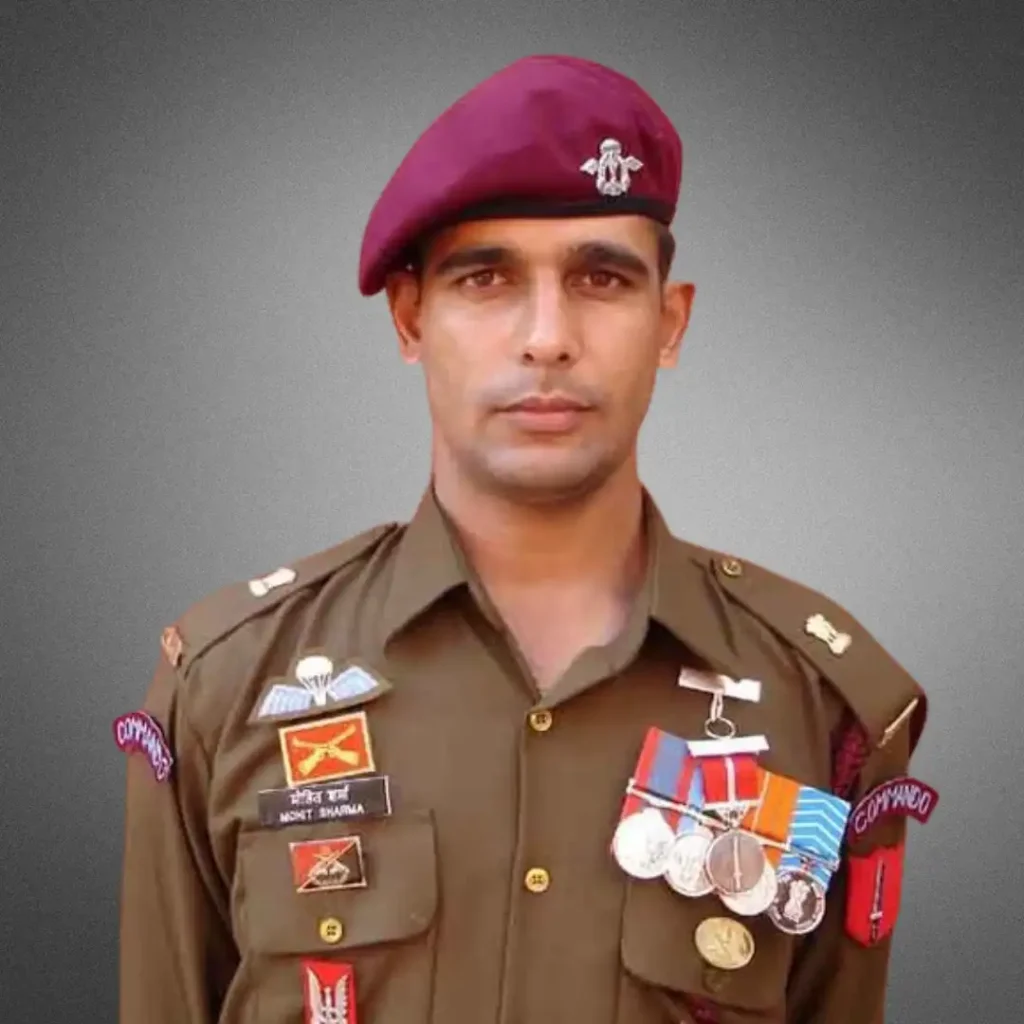
When people talk about India’s bravest soldiers, the name Major Mohit Sharma, Ashok Chakra (Posthumous), Sena Medal is remembered with immense respect. He was not only an elite 1 PARA (Special Forces) officer but also a fearless leader who always placed the lives of his fellow soldiers above his own. His courage extended beyond the battlefield. He willingly entered the dangerous world of terrorism under a false identity, gathered crucial intelligence for the Indian Army, and later sacrificed his life while rescuing his comrades during one of the toughest counter-terrorism operations in Kashmir.
Major Mohit Sharma’s story is much more than a tale of bravery. It is the inspiring journey of a young man who dreamed of serving the nation, trained relentlessly to become one of India’s finest Special Forces officers, and ultimately earned the country’s highest peacetime gallantry award the Ashok Chakra. His life continues to inspire defence aspirants, soldiers, and millions of Indians who believe that true patriotism is demonstrated through action.
This biography explores every important chapter of his life, including his childhood, education, military journey, undercover missions, leadership qualities, and the supreme sacrifice that made him immortal in the history of the Indian Army.
Major Mohit Sharma Quick Overview
| Particular | Details |
|---|---|
| Full Name | Major Mohit Sharma |
| Nicknames | Chintu (Family), Mike (Army Friends) |
| Rank | Major |
| Service Number | IC-59066N |
| Birth Date | 13 January 1978 |
| Birthplace | Rohtak, Haryana, India |
| Hometown | Ghaziabad, Uttar Pradesh |
| Nationality | Indian |
| Profession | Indian Army Officer |
| Regiment | 5 Madras Regiment |
| Special Unit | 1 PARA (Special Forces) |
| Service Years | 1999–2009 |
| Education | National Defence Academy (NDA), Indian Military Academy (IMA) |
| Awards | Ashok Chakra (Posthumous), Sena Medal, COAS Commendation Card |
| Wife | Major Rishima Sharma |
| Martyrdom | 21 March 2009 |
| Place of Martyrdom | Hafruda Forest, Kupwara, Jammu & Kashmir |
Who Was Major Mohit Sharma?
Major Mohit Sharma was one of the most courageous officers in the history of the Indian Army. Serving with the elite 1 PARA (Special Forces), he became known for accepting missions that required exceptional courage, patience, intelligence, and leadership. Unlike conventional military operations, Special Forces missions often take place deep inside hostile territory where a single mistake can put an entire team at risk.
He believed that true leadership meant leading from the front instead of giving orders from behind. Whether conducting covert intelligence missions or leading assault teams through dense forests, he consistently volunteered for the most dangerous responsibilities.
Although his military career lasted less than a decade, it left an unforgettable impact. Before receiving the Ashok Chakra, he was awarded the Sena Medal for successfully carrying out an undercover mission in Jammu and Kashmir. During that operation, he disguised himself as a local Kashmiri youth, infiltrated a terrorist network, gathered vital intelligence, and helped security forces eliminate several dangerous militants.
His final operation in the Hafruda forests of Kupwara became one of the greatest examples of courage and selfless leadership in Indian military history.
Major Mohit Sharma Early Life
Every great soldier begins life as an ordinary child with extraordinary dreams. Major Mohit Sharma was born into a middle-class family that valued discipline, honesty, and education. From an early age, he displayed qualities that later shaped him into an exceptional Army officer. He was energetic, fearless, curious, and always willing to take on new challenges.
His family lovingly called him “Chintu,” while his fellow officers later knew him as “Mike.” As a student, he loved outdoor activities, sports, and adventure. Rather than choosing the easier path, he constantly looked for opportunities to challenge himself physically and mentally.
People who knew him during his childhood often described him as cheerful, confident, and naturally gifted with leadership qualities. He could easily make friends, motivate others, and take responsibility during group activities. These qualities became his greatest strengths during his military career.
Instead of growing up with a desire for comfort, he developed a mindset focused on discipline, hard work, and service to the nation.
Major Mohit Sharma Date of Birth, Age & Birthplace
Major Mohit Sharma was born on 13 January 1978 in Rohtak, Haryana. His family later settled in Ghaziabad, Uttar Pradesh, where he spent much of his childhood and completed his education.
He attained martyrdom on 21 March 2009 during a counter-terrorism operation in the dense Hafruda Forest of Kupwara district in Jammu and Kashmir. At the time of his sacrifice, he was just 31 years old, yet his achievements had already secured him a permanent place among India’s greatest military heroes.
Family Background of Major Mohit Sharma
Major Mohit Sharma belonged to a supportive and close-knit family. His father, Rajendra Prasad Sharma, and mother, Sushila Sharma, always encouraged him to pursue his dreams, even when they involved choosing one of the most challenging professions in the country.
The values he learned at home played a significant role in shaping his personality. Discipline, honesty, respect, and dedication were not merely lessons but principles that guided his everyday life.
Although his parents understood the dangers associated with military service, they never discouraged his ambitions. Instead, they stood firmly behind his decision to serve the nation with honour and courage.
Even after his martyrdom, his family has continued to preserve his legacy by inspiring young Indians through his remarkable story of sacrifice and patriotism.
Major Mohit Sharma Education & School Life
Major Mohit Sharma completed his early education at reputed schools before finishing his higher secondary education at Delhi Public School (DPS), Ghaziabad, in 1995. Before studying at DPS, he attended Manav Sthali School in Delhi and Holy Angels’ School in Sahibabad.
Teachers remembered him as a disciplined and intelligent student who balanced academics with sports and extracurricular activities. Rather than focusing only on examination results, he believed in developing a well-rounded personality.
After completing school, he briefly joined Shri Sant Gajanan Maharaj College of Engineering in Shegaon, Maharashtra. Although engineering offered a promising career, he soon realised that his true passion was serving the nation through the armed forces.
Major Mohit Sharma Dream of Joining the Indian Army
For Mohit Sharma, joining the Indian Army was never just a career choice it was his lifelong dream.
From a young age, he admired soldiers who protected India’s borders under extremely difficult conditions. Their stories of courage, sacrifice, and patriotism inspired him to dedicate his own life to the nation.
While many of his classmates planned conventional careers, Mohit began preparing for the National Defence Academy (NDA) examination. His determination was so strong that after receiving admission to an engineering college, he chose to leave it behind when he qualified for the NDA.
Many people were surprised by his decision because engineering promised a secure future, while military service demanded courage and sacrifice. However, Mohit believed that true satisfaction came from serving a purpose greater than oneself.
That single decision changed the course of his life and eventually made him one of India’s most respected military heroes.
Training at NDA and Indian Military Academy
Selection into the National Defence Academy (NDA) marks the beginning of an extremely demanding journey. Cadets undergo rigorous physical, academic, and military training that prepares them for leadership under the toughest conditions.
Mohit Sharma embraced every challenge with determination and enthusiasm. During his training at the NDA, he earned a reputation as an outstanding all-round cadet. He performed exceptionally well in horse riding, boxing, swimming, and physical endurance exercises. His instructors admired his discipline, while his fellow cadets respected his willingness to help others.
After successfully completing his NDA training, he joined the Indian Military Academy (IMA), Dehradun, where his leadership abilities became even more evident. He was appointed Battalion Cadet Adjutant (BCA), one of the most prestigious appointments awarded to outstanding cadets. During his time at the academy, he also had the honour of meeting the then President of India, Dr. K. R. Narayanan.
His instructors believed he possessed the rare combination of physical toughness, mental strength, and leadership qualities required to become an exceptional Army officer.
Commission into the Indian Army
On 11 December 1999, Mohit Sharma was commissioned into the 5th Battalion of the Madras Regiment, officially beginning his career in the Indian Army.
His first posting was in Hyderabad before he was deployed with 38 Rashtriya Rifles in Jammu and Kashmir, where the Army was actively conducting counter-insurgency operations.
Service in Kashmir exposed him to the realities of modern warfare. Operations often involved long patrols, intelligence-based missions, and encounters with heavily armed terrorists hiding in difficult mountainous terrain.
Even during the early years of his career, Mohit displayed exceptional courage, professionalism, and leadership. His dedication earned him the Chief of Army Staff Commendation Card, recognising his outstanding contribution during counter-insurgency operations.
This recognition further strengthened his determination to join India’s elite Special Forces.
Joining 1 PARA (Special Forces)
Although he had already established himself as a capable Army officer, Mohit Sharma wanted to push his limits even further. His dream was to earn the prestigious maroon beret of the Parachute Regiment (Special Forces).
In June 2003, after successfully completing one of the toughest Special Forces probation processes in the world, he joined 1 PARA (Special Forces).
The probation tested every aspect of a soldier’s physical and mental endurance. Candidates faced extreme fatigue, sleep deprivation, long-distance marches, survival training, continuous field exercises, and intense psychological challenges. Only a small number of volunteers completed the course successfully.
For Mohit Sharma, becoming part of the Special Forces was not just a professional achievement it was the fulfilment of a lifelong ambition.
Why Major Mohit Sharma Chose Special Forces
Many officers choose to continue serving in regular infantry units, but Mohit Sharma wanted to challenge himself every single day. He believed that the Special Forces represented the highest standards of military excellence.
Special Forces personnel are trained for missions such as hostage rescue, deep reconnaissance, counter-terrorism operations, covert surveillance, high-altitude warfare, and strategic raids. These operations demand exceptional physical fitness, mental resilience, and the ability to make critical decisions within seconds.
Mohit’s fearless nature perfectly matched the demands of Special Forces service. He viewed difficult missions as opportunities to prove himself and contribute more effectively to national security.
His decision reflected the qualities that defined his personality courage, determination, discipline, and an unwavering commitment to serving the nation.
Training of a PARA SF Officer
After joining 1 PARA (Special Forces), Major Mohit Sharma underwent advanced military training that prepared him for some of the most dangerous operations undertaken by the Indian Army.
His training included close-quarter combat, mountain warfare, jungle survival, advanced weapon handling, tactical intelligence gathering, night operations, combat navigation, parachute jumps, hostage rescue techniques, and small-team leadership.
The objective of this training was to prepare soldiers for situations where they would have little or no support, operate deep inside hostile territory, and make life-saving decisions under extreme pressure.
By successfully completing this demanding training, Mohit Sharma demonstrated exceptional physical endurance, mental strength, and tactical expertise, earning his place among India’s finest Special Forces officers.
Major Mohit Sharma Early Military Career
The early years of Major Mohit Sharma’s military career laid the foundation for the extraordinary achievements that followed. Serving first with the Madras Regiment and later with Rashtriya Rifles, he gained extensive operational experience in Jammu and Kashmir.
Senior officers quickly recognised his ability to remain calm under pressure. Whether leading patrols through dense forests or planning search operations in remote villages, he consistently demonstrated confidence, maturity, and sound judgment.
His fellow soldiers trusted him because he never asked anyone to perform a task that he was unwilling to undertake himself. This leadership style earned him immense respect within his unit and established him as an ideal officer for Special Forces operations.
These formative years provided him with the operational knowledge, local understanding, and practical experience that would later enable him to undertake one of the Indian Army’s most remarkable undercover counter-terrorism missions.
First Counter-Insurgency Operations
Soon after joining active service in Jammu and Kashmir, Major Mohit Sharma gained first-hand experience in counter-insurgency warfare. Unlike conventional battles, these operations demanded patience, precise planning, and constant alertness. Terrorists often hid in dense forests, remote villages, and mountainous regions, making every mission unpredictable.
As part of 38 Rashtriya Rifles and later 1 PARA (Special Forces), Mohit participated in numerous search-and-destroy operations. He quickly earned the confidence of his senior officers because of his ability to remain calm under pressure and make sound decisions in difficult situations.
His leadership style was different from many others. Instead of directing operations from a safe distance, he always preferred to lead from the front. Whether it involved climbing steep mountain slopes, conducting night patrols, or entering hostile areas, he believed that an officer should share every risk faced by his soldiers.
These early operations helped him understand the tactics used by terrorist groups operating in Kashmir. He closely studied their movement patterns, communication methods, hideouts, and survival techniques. This operational knowledge later became invaluable during one of the most daring undercover missions undertaken by the Indian Army.
Undercover Mission – The Story of “Iftikhar Bhatt”
Among all the operations carried out by Major Mohit Sharma, his undercover mission remains one of the most remarkable examples of courage and intelligence in Indian military history.
During the early 2000s, security forces were trying to dismantle terrorist networks operating in Jammu and Kashmir. Many of these groups had developed strong local support systems, making it extremely difficult for the Army to identify their leaders and operational bases.
To overcome this challenge, an extraordinary plan was prepared.
Major Mohit Sharma volunteered to infiltrate terrorist ranks by assuming the identity of a local Kashmiri youth named “Iftikhar Bhatt.” The mission required him to leave behind his real identity completely and live among heavily armed terrorists without revealing that he was an Indian Army officer.
This was not a mission that lasted for a few hours or days. It required immense patience, mental strength, and absolute confidence. Discovery would almost certainly have resulted in torture and death.
Despite the risks, Major Mohit Sharma accepted the assignment without hesitation because he believed that accurate intelligence could save the lives of countless soldiers and civilians.
How Major Mohit Sharma Gained the Trust of Terrorists
Building trust inside a terrorist network demanded far more than courage. Every word, action, and decision had to appear genuine.
Major Mohit Sharma carefully adopted the appearance, behaviour, language, and lifestyle expected from a local resident. He learned local customs, adapted his communication style, and blended into the environment so naturally that the terrorists never suspected his true identity.
Rather than acting in haste, he patiently earned their confidence over time. He observed conversations, understood internal hierarchies, and identified key commanders responsible for planning attacks against Indian security forces.
His calm personality proved to be one of his greatest strengths. Even while surrounded by dangerous militants, he remained composed and focused on his objective.
The success of the mission depended not only on his bravery but also on his intelligence, discipline, and remarkable ability to think several steps ahead of the enemy.
Intelligence Gathered During the Secret Mission
While operating under his false identity, Major Mohit Sharma collected intelligence that proved invaluable to the Indian Army.
He identified terrorist hideouts hidden deep inside forests and remote villages. He gathered information about infiltration routes used to cross the Line of Control, locations where weapons and ammunition were stored, communication methods, meeting points, and future attack plans.
Every piece of information had to be passed to Indian security forces without exposing his identity. This required careful planning and flawless execution.
The intelligence he provided enabled the Army to launch precise operations instead of broad search missions. As a result, security forces could strike terrorist groups with greater accuracy while reducing risks to civilians and soldiers.
Military experts often describe intelligence as the most important weapon in counter-terrorism operations, and Major Mohit Sharma demonstrated exactly why reliable intelligence can completely change the outcome of a conflict.
Terrorists Neutralized Because of His Intelligence
The intelligence gathered by Major Mohit Sharma directly contributed to several successful counter-terrorism operations conducted by the Indian Army.
Based on the information he secretly supplied, security forces identified multiple terrorist hideouts, intercepted infiltration attempts, and eliminated several highly trained militants responsible for planning attacks in Jammu and Kashmir.
These operations significantly weakened terrorist networks in the region and prevented future attacks against both civilians and security personnel.
Although many details of these classified operations remain confidential even today, it is widely acknowledged that his undercover mission saved numerous lives and became one of the finest intelligence successes achieved by the Indian Army during that period.
His willingness to risk his own life for the safety of others earned him immense respect within the Special Forces community.
Sena Medal – Why He Received It
The extraordinary success of Major Mohit Sharma’s undercover mission did not go unnoticed.
For displaying exceptional courage, outstanding leadership, and remarkable devotion to duty during counter-insurgency operations, he was awarded the Sena Medal.
The award recognised not only his bravery but also his intelligence and tactical brilliance. Unlike many gallantry awards that honour direct combat, the Sena Medal acknowledged his ability to gather life-saving intelligence while operating undercover inside hostile terrorist networks.
Receiving this honour established him as one of the most capable young officers serving in the Indian Army.
However, those who knew him personally often said that medals were never his motivation. His greatest satisfaction came from completing every mission successfully and ensuring the safety of his fellow soldiers.
Major Mohit Sharma Leadership Style and Personality
Major Mohit Sharma possessed leadership qualities that inspired everyone who served alongside him.
He believed that respect could never be demanded it had to be earned through actions. Instead of asking his soldiers to take risks alone, he always stood beside them during dangerous operations.
His calm nature allowed him to make balanced decisions even under intense pressure. Whether planning operations or responding to unexpected situations, he remained composed and focused.
Despite his disciplined military personality, he was known for his cheerful attitude and friendly nature. He encouraged young soldiers, motivated his teammates, and maintained high morale even during long deployments in difficult conditions.
Senior officers admired his professionalism, while junior soldiers trusted him because they knew he genuinely cared for their safety.
These qualities transformed him from an excellent officer into an exceptional leader.
Major Mohit Sharma’s Final Operation
In March 2009, intelligence agencies received information about the presence of heavily armed terrorists hiding inside the dense Hafruda Forest near Kupwara in Jammu and Kashmir.
The forest was one of the most challenging operational areas in the region. Thick vegetation, rugged terrain, steep slopes, and limited visibility made military operations extremely dangerous.
Major Mohit Sharma was leading a team of 1 PARA (Special Forces) commandos assigned to track and eliminate the terrorists.
As the team advanced through the forest, they suddenly came under heavy automatic gunfire from well-concealed militants.
The terrorists had chosen advantageous positions, allowing them to launch a surprise attack.
Without wasting a moment, Major Mohit Sharma reorganised his team and began directing the operation despite the intense enemy fire.
His experience and quick decision-making prevented the ambush from turning into a disaster.
Major Mohit Sharma Story – Kupwara (Hafruda Forest) Encounter
The encounter that followed became one of the most heroic chapters in the history of the Indian Army.
As the exchange of fire intensified, two commandos from his team suffered serious injuries. They were lying exposed to enemy fire and unable to move to safety.
Recognising the danger, Major Mohit Sharma made an extraordinary decision.
Ignoring the continuous stream of bullets, he rushed towards his injured comrades to rescue them.
While providing covering fire, he personally pulled the wounded soldiers away from the terrorists’ line of fire, ensuring that they could receive medical assistance.
Even after rescuing them, he refused to withdraw.
Instead, he continued leading the assault against the terrorists, encouraging his men to keep advancing despite the difficult circumstances.
During the fierce firefight, Major Mohit Sharma engaged the terrorists at close range and succeeded in eliminating several militants.
However, while protecting his team and continuing the assault, he sustained multiple gunshot wounds.
Despite being critically injured, he continued fighting until the operation was brought under control.
His courage inspired every soldier present during the encounter.
The operation successfully prevented the terrorists from escaping and demonstrated the extraordinary professionalism of the Special Forces.
How He Saved His Fellow Soldiers
The defining moment of Major Mohit Sharma’s final operation came when he chose the lives of his comrades over his own safety.
Many leaders issue commands from secure positions, but Major Mohit Sharma believed that leadership required personal sacrifice.
When two commandos were seriously injured during the firefight, he exposed himself to direct enemy fire to rescue them.
This decision dramatically increased the danger to his own life, yet he never hesitated.
His courageous action gave the injured soldiers a chance to survive while allowing the remaining commandos to reorganise and continue the mission.
Military experts often describe this moment as the perfect example of battlefield leadership, where an officer willingly accepts the greatest risk to protect his men.
The soldiers he led never forgot this act of selfless courage.
The Supreme Sacrifice
During the intense battle in the Hafruda Forest on 21 March 2009, Major Mohit Sharma received multiple gunshot wounds while engaging the terrorists and protecting his team.
Even after being critically injured, he continued directing the operation and fighting until he collapsed from his injuries.
His determination ensured that the terrorists could not break through the Special Forces’ cordon or inflict greater casualties on the team.
Major Mohit Sharma attained martyrdom while performing his duty with unmatched courage and devotion to the nation.
His sacrifice reflected the highest traditions of the Indian Army, where the safety of the mission and fellow soldiers always comes before personal survival.
Although his life ended at the age of just 31, his courage transformed him into an enduring symbol of patriotism and military excellence.
Ashok Chakra Award
For displaying the highest degree of courage, exceptional leadership, and supreme sacrifice during the Kupwara operation, Major Mohit Sharma was posthumously awarded the Ashok Chakra, India’s highest peacetime gallantry award.
The honour recognised not only his actions during the final encounter but also his outstanding service throughout his military career.
Receiving the Ashok Chakra placed Major Mohit Sharma among the nation’s greatest military heroes whose bravery continues to inspire generations of Indians.
Today, his name is spoken alongside the finest soldiers who demonstrated extraordinary courage in defence of the country.
Ashok Chakra Citation (Summary)
The official Ashok Chakra citation highlights Major Mohit Sharma’s fearless leadership during the Hafruda Forest operation.
It recognises how he led his Special Forces team against heavily armed terrorists, rescued injured commandos while under direct enemy fire, personally engaged the militants in close combat, and continued fighting despite sustaining serious injuries.
The citation concludes that his conspicuous bravery, indomitable spirit, exceptional leadership, and supreme sacrifice were in keeping with the highest traditions of the Indian Army.
His actions remain one of the finest examples of courage and selfless service in India’s military history.
Major Mohit Sharma Wife (Major Rishima Sharma)
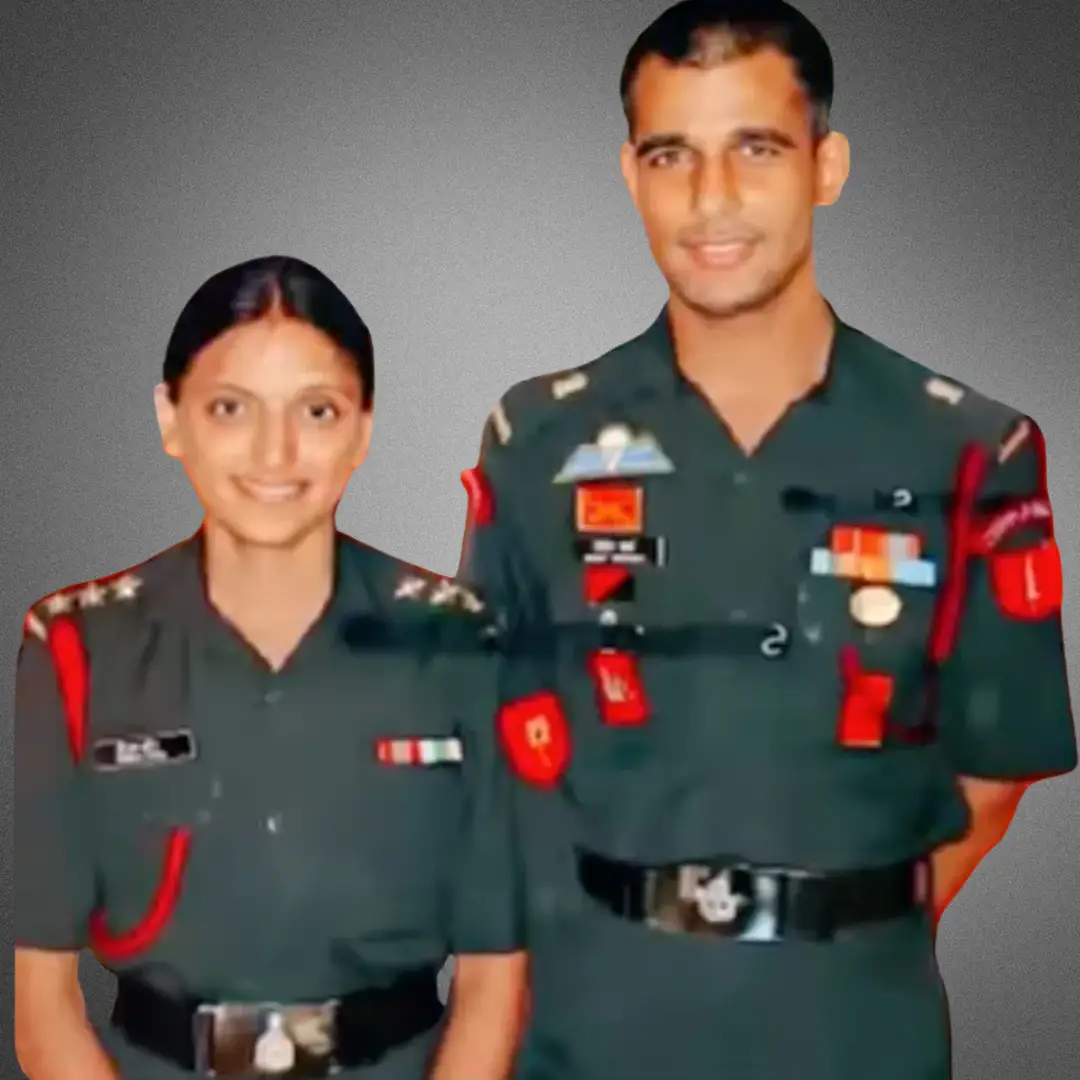
Behind every brave soldier is a family that silently shares the challenges of military life. Major Mohit Sharma was married to Major Rishima Sharma, an officer in the Indian Army. Their relationship was built on mutual respect, dedication, and a shared commitment to serving the nation.
Both understood the responsibilities and risks that came with wearing the Army uniform. Their demanding careers often required long periods away from home, but they remained deeply supportive of each other’s professional duties.
Following Major Mohit Sharma’s martyrdom, Major Rishima Sharma has continued to honour his memory and has spoken on various occasions about his courage, dedication, and love for the nation. She has become a symbol of strength and resilience for many military families across India.
Major Mohit Sharma Personal Life
Although Major Mohit Sharma spent most of his adult life serving in difficult operational areas, he was known for his warm personality and humble nature. Friends and fellow officers remember him as someone who always carried a smile, even during the most demanding situations.
Despite the intensity of military life, he remained closely connected with his family and valued every opportunity to spend time with them. His simplicity and down-to-earth attitude earned him the respect of everyone who knew him.
He never sought fame or recognition. Instead, he believed that a soldier’s greatest achievement was fulfilling his duty with honesty, courage, and dedication. His life reflected discipline not only in uniform but also in his personal values and everyday behaviour.
Major Mohit Sharma Hobbies and Interests
Outside military operations, Major Mohit Sharma enjoyed activities that helped him stay physically and mentally fit. Sports were an important part of his life from an early age, and he believed that physical fitness was essential for a soldier.
He enjoyed outdoor adventures, endurance training, and activities that challenged both the body and the mind. Horse riding, boxing, swimming, and long-distance running were among the disciplines he excelled in during his training years.
Reading about military history and learning from the experiences of great military leaders also interested him. He constantly worked on improving himself, believing that every day offered an opportunity to become a better officer and a better human being.
Major Mohit Sharma Physical Appearance
| Attribute | Details |
|---|---|
| Height | Approximately 5 feet 10 inches (178 cm) |
| Weight | Around 72–75 kg (Approx.) |
| Eye Colour | Black |
| Hair Colour | Black |
| Build | Athletic |
| Personality | Calm, Confident, Disciplined |
Major Mohit Sharma Career Timeline
| Year | Achievement |
|---|---|
| 1978 | Born in Rohtak, Haryana |
| 1995 | Qualified for the National Defence Academy |
| 1995–1998 | Training at NDA |
| 1998–1999 | Training at the Indian Military Academy |
| 11 December 1999 | Commissioned into the 5 Madras Regiment |
| 2000 | Posted with 38 Rashtriya Rifles in Jammu & Kashmir |
| 2003 | Successfully joined 1 PARA (Special Forces) |
| 2004 | Completed a remarkable undercover mission against terrorists |
| 2005 | Awarded the Sena Medal |
| 2009 | Led the Hafruda Forest operation in Kupwara |
| 21 March 2009 | Attained martyrdom during the operation |
| 2009 | Awarded the Ashok Chakra (Posthumous) |
Awards and Honours
| Award | Year | Reason |
|---|---|---|
| Chief of Army Staff Commendation Card | Early Service | Outstanding operational performance |
| Sena Medal | 2005 | Exceptional bravery during undercover counter-terrorism operations |
| Ashok Chakra (Posthumous) | 2009 | Supreme courage and sacrifice during the Kupwara encounter |
Memorials Named After Major Mohit Sharma
Major Mohit Sharma’s sacrifice has been honoured through various memorials, educational institutions, roads, and military establishments across India. His name continues to inspire future generations of soldiers and civilians alike.
Several schools and public places organise annual events to remember his extraordinary courage. His story is frequently shared during military training programmes to teach leadership, discipline, and selfless service.
His family has also played an important role in preserving his legacy by supporting initiatives that spread awareness about his life and inspire young Indians to serve the nation with integrity.
Today, his memory lives on not only through monuments but also through the countless people who draw inspiration from his remarkable journey.
Books and Movies Inspired by His Story
Although no full-length feature film has yet been made exclusively on Major Mohit Sharma’s life, his story has been featured in several documentaries, television programmes, defence publications, and inspirational books highlighting India’s gallantry award winners.
His undercover mission and final battle have often been discussed in military literature and documentaries that focus on the courage of the Indian Armed Forces.
Many defence experts believe that his life has all the elements of an inspiring biographical film, including determination, sacrifice, leadership, patriotism, and extraordinary courage.
Famous Quotes About Major Mohit Sharma
Although Major Mohit Sharma was known more for his actions than his words, his life continues to inspire many meaningful thoughts.
“A true leader always walks in front of his team.”
“Service before self is not just a motto it was the way Major Mohit Sharma lived.”
“Heroes are remembered not because they lived long, but because they lived with courage.”
“The uniform gives responsibility, but character creates a soldier.”
These quotes reflect the values that defined his military career and continue to inspire future generations.
Major Mohit Sharma Death
On 21 March 2009, Major Mohit Sharma laid down his life during a fierce encounter with terrorists in the dense Hafruda Forest of Kupwara district, Jammu and Kashmir.
While leading his team during the operation, he came under heavy enemy fire. Two of his commandos suffered serious injuries and were trapped in an exposed position.
Without considering his own safety, Major Mohit Sharma rushed forward, rescued the injured soldiers, and continued engaging the terrorists at close range.
During the intense exchange of fire, he sustained multiple gunshot wounds. Despite his injuries, he continued leading the assault until the terrorists were effectively neutralised and the mission was secured.
His courage ensured that the operation succeeded while saving the lives of his fellow soldiers.
At the age of only 31, Major Mohit Sharma made the supreme sacrifice in the service of the nation. His martyrdom remains one of the finest examples of courage and leadership in the history of the Indian Army.
Leadership Lessons from Major Mohit Sharma
Major Mohit Sharma’s life offers valuable leadership lessons that extend far beyond the battlefield.
He demonstrated that true leadership begins with leading by example. Rather than asking others to take risks, he accepted the greatest dangers himself.
His ability to remain calm under pressure teaches the importance of clear thinking during difficult situations. Even in life-threatening circumstances, he focused on protecting his team and completing the mission.
Another important lesson from his life is the value of preparation. His success during undercover operations was possible because of months of careful planning, observation, and discipline.
Above all, he showed that selfless service is the highest form of leadership. His willingness to sacrifice everything for his comrades and his country continues to inspire military personnel, students, professionals, and young leaders across India.
Unknown Facts About Major Mohit Sharma
Many people know Major Mohit Sharma for receiving the Ashok Chakra, but several lesser-known facts make his story even more inspiring.
- His childhood nickname was “Chintu.”
- Fellow officers often called him “Mike.”
- He left engineering college after qualifying for the National Defence Academy.
- Major Mohit Sharma successfully completed one of the toughest Special Forces probation courses in the world.
- Before receiving the Ashok Chakra, he had already been honoured with the Sena Medal.
- His undercover identity during a counter-terrorism mission was “Iftikhar Bhatt.”
- Major Mohit Sharma personally rescued injured commandos during his final operation despite heavy enemy fire.
- His wife, Major Rishima Sharma, also served in the Indian Army.
- His life is widely studied in military leadership discussions.
- Major Mohit Sharma is remembered as one of the most courageous officers in the history of 1 PARA (Special Forces).
Why Major Mohit Sharma Is Remembered Even Today
More than a decade after his sacrifice, Major Mohit Sharma continues to inspire millions of Indians.
His courage was not limited to a single battle. Throughout his career, he repeatedly accepted dangerous assignments that required exceptional bravery, intelligence, and determination.
His undercover mission demonstrated remarkable patience and strategic thinking, while his final operation showcased the highest level of battlefield leadership.
For defence aspirants, he represents the ideals of discipline, courage, and commitment. For serving soldiers, he remains a role model who always placed the mission and his comrades before himself.
His story reminds every Indian that true heroes are those who silently protect the nation without expecting recognition or reward.
FAQs
Who was Major Mohit Sharma?
Major Mohit Sharma was an officer of the Indian Army’s 1 PARA (Special Forces) and a recipient of the Ashok Chakra (Posthumous) for his exceptional bravery during a counter-terrorism operation in Jammu and Kashmir.
Why did Major Mohit Sharma receive the Ashok Chakra?
He received the Ashok Chakra for displaying extraordinary courage, rescuing injured commandos under heavy enemy fire, eliminating terrorists, and making the supreme sacrifice during the Hafruda Forest operation in 2009.
What was the “Iftikhar Bhatt” mission?
It was an undercover counter-terrorism operation in which Major Mohit Sharma infiltrated terrorist networks by assuming the identity of a local Kashmiri youth to gather valuable intelligence for the Indian Army.
Which regiment did Major Mohit Sharma belong to?
He was initially commissioned into the 5 Madras Regiment and later joined 1 PARA (Special Forces).
Was Major Mohit Sharma married?
Yes. He was married to Major Rishima Sharma, who also served in the Indian Army.
How old was Major Mohit Sharma when he died?
He was 31 years old at the time of his martyrdom on 21 March 2009.
Where did Major Mohit Sharma attain martyrdom?
He was martyred during a counter-terrorism operation in the Hafruda Forest, Kupwara district, Jammu and Kashmir.
Which gallantry awards did Major Mohit Sharma receive?
He was awarded the Sena Medal and later the Ashok Chakra (Posthumous), India’s highest peacetime gallantry award.
Why is Major Mohit Sharma considered a national hero?
He is remembered for his fearless undercover mission, outstanding leadership, extraordinary courage in combat, and supreme sacrifice while saving the lives of his fellow soldiers.
Conclusion
Major Mohit Sharma’s life is a timeless example of courage, patriotism, and selfless leadership. From his childhood dream of serving the nation to becoming one of India’s finest Special Forces officers, every chapter of his journey reflects determination and unwavering commitment to duty.
His successful undercover mission demonstrated exceptional intelligence and patience, while his final battle in the Hafruda Forest showcased unmatched bravery. Even after sustaining serious injuries, he continued fighting to protect his team and ensure the success of the mission. Such acts of courage earned him the Ashok Chakra and a permanent place among India’s greatest military heroes.
Although his life was tragically short, his legacy continues to inspire generations of Indians. Major Mohit Sharma proved that true heroes are not measured by the length of their lives but by the values they uphold and the sacrifices they make. His story will forever remain a shining symbol of honour, courage, and devotion to the nation.
Also, Read About: Major Sandeep Unnikrishnan Biography || Major Iqbal