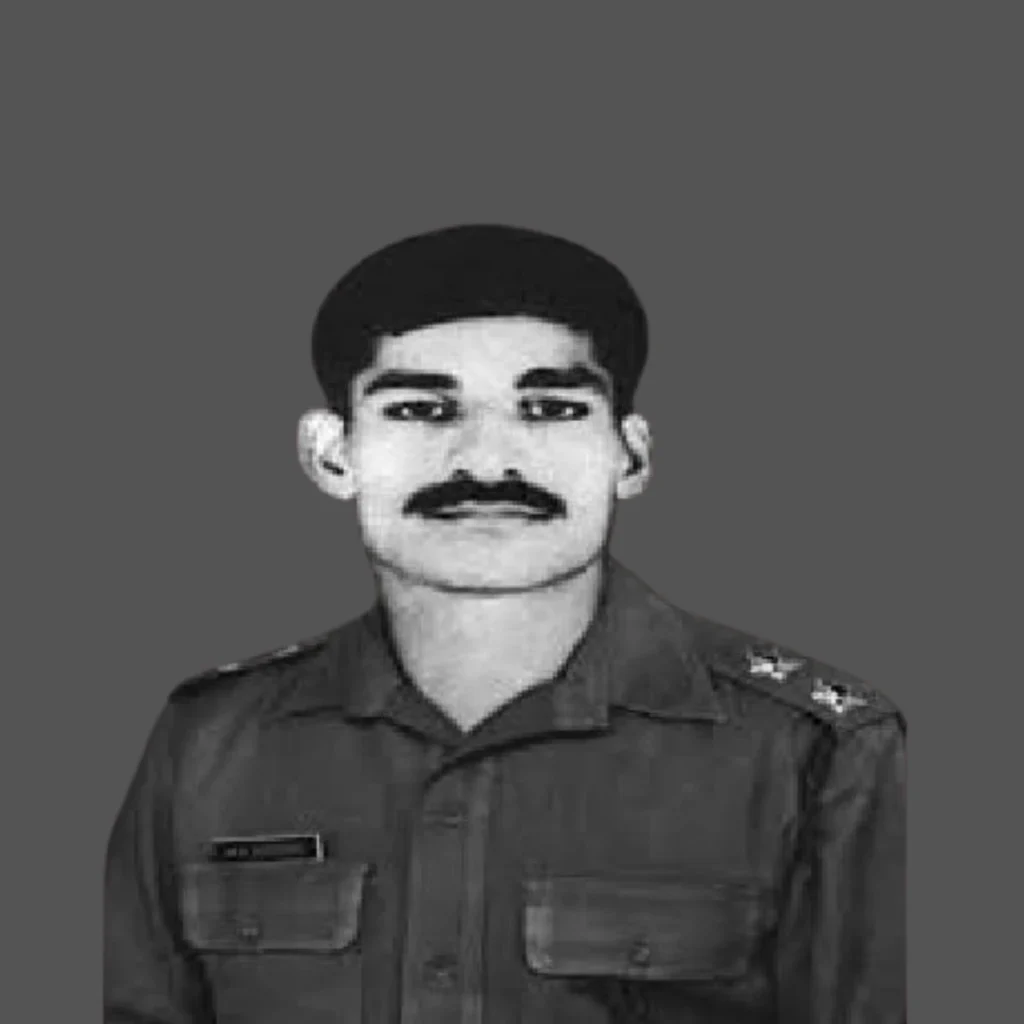
Lieutenant Ram Prakash Roperia was a brave officer of the Indian Army whose name became associated with exceptional courage during Operation Blue Star in June 1984. Serving with the 26th Battalion of the Madras Regiment, he demonstrated remarkable leadership while commanding his men during one of the most difficult military operations of his short career. Despite coming under intense fire, he repeatedly led his soldiers toward a heavily defended position and continued his mission even after suffering serious injuries.
Roperia’s military career lasted only a few years, but his actions during his final operation established a lasting legacy. He was serving as the officiating Officer Commanding of ‘C’ Company, 26 Madras, when his unit was tasked with securing a strongly fortified building within the Golden Temple complex in Amritsar. His determination to lead from the front and his refusal to abandon the mission despite repeated setbacks ultimately earned him India’s highest peacetime gallantry award, the Ashoka Chakra, posthumously.
Who Was Lieutenant Ram Prakash Roperia?
Lieutenant Ram Prakash Roperia was an Indian Army officer belonging to the Madras Regiment. He was associated with 26 Madras and had developed a reputation for discipline, courage and leadership. Born in the Hisar region of Haryana, he studied at Sainik School Kunjpura before pursuing higher education in agriculture. His educational journey was followed by military training and his commissioning into the Indian Army in December 1981.
Roperia’s most significant contribution came during Operation Blue Star in June 1984. At the time, he was serving as the officiating Officer Commanding of ‘C’ Company. His company was given the challenging task of securing the first floor of a heavily defended building, and Roperia personally led repeated attempts to reach the position. His actions during the operation eventually resulted in his receiving the Ashoka Chakra after his death.
Lieutenant Ram Prakash Roperia Biography Overview
| Category | Details |
|---|---|
| Full Name | Lieutenant Ram Prakash Roperia |
| Rank | Lieutenant |
| Service Number | IC-39994 |
| Regiment | The Madras Regiment |
| Battalion | 26 Madras |
| Birthplace | Pali village, Hisar region, Haryana |
| Birth Date | Commonly reported as 10 June 1959 |
| School | Sainik School Kunjpura |
| Higher Education | B.Sc. (Hons.) Agriculture |
| Commissioned | 19 December 1981 |
| Company | ‘C’ Company, 26 Madras |
| Major Operation | Operation Blue Star |
| Place of Operation | Amritsar, Punjab |
| Year of Martyrdom | 1984 |
| Gallantry Award | Ashoka Chakra |
| Award Status | Posthumous |
Lieutenant Ram Prakash Roperia Early Life and Childhood
Lieutenant Ram Prakash Roperia spent his early years in Haryana and grew up in an environment that valued education, discipline and hard work. His early schooling began at a village school before he moved to Sainik School Kunjpura. The institution played an important role in shaping many young students who later pursued careers in the armed forces, and Roperia was among its notable alumni.
His school years helped develop qualities that later became important in his Army career. He was interested in studies as well as physical activities and sports. The disciplined environment of Sainik School Kunjpura provided him with early exposure to military-style training, leadership and physical fitness.
Lieutenant Ram Prakash Roperia Birth and Hometown
Ram Prakash Roperia is commonly reported to have been born on 10 June 1959 in Pali village in the Hisar region of Haryana. Some institutional records have listed his birth date as 9 June 1959, creating a small discrepancy between available sources. For this reason, his birth date should preferably be presented with this qualification rather than treating one date as completely undisputed.
His association with Haryana remained an important part of his identity. Pali village is remembered in connection with his life and military service, particularly because he later became one of the region’s notable recipients of the Ashoka Chakra.
Lieutenant Ram Prakash Roperia Family Background
Ram Prakash Roperia was the son of Shri Bhal Singh. Public records about his family are relatively limited because he lived and served before the widespread availability of digital biographies and social media. Most reliable accounts focus on his education, military career, bravery during Operation Blue Star and posthumous gallantry award rather than providing extensive details about his private family life.
His family later became connected with his national recognition when the Ashoka Chakra was awarded to him posthumously. His father is reported to have received the honour on his behalf, representing the family at the time of the award ceremony.
Lieutenant Ram Prakash Roperia Education
Roperia began his education in his local area before joining Sainik School Kunjpura. The school provided him with an academically disciplined environment and introduced him to physical training and military-oriented activities. His time at the institution became an important foundation for his later decision to pursue a career connected with national service.
After completing his schooling, he continued his education in agriculture and obtained a B.Sc. (Hons.) in Agriculture. His academic background is noteworthy because he had the opportunity to pursue a civilian professional career but ultimately chose the Indian Army.
Lieutenant Ram Prakash Roperia Interest in Agriculture and Studies
Before entering military service, Ram Prakash Roperia studied agriculture at university level. Agriculture was an important field of education, particularly for students from rural backgrounds, and his academic choice reflected a practical professional direction. However, his subsequent decision to enter the Army took his career in a completely different direction.
His education nevertheless remained part of his broader personality. He combined academic preparation with the discipline and physical development he had received at Sainik School Kunjpura. These qualities later became valuable during his military service.
Why Did Ram Prakash Roperia Join the Indian Army?
There is no widely available authenticated interview in which Roperia personally explained the exact reason for choosing the Army. However, his education at Sainik School Kunjpura appears to have played an important role in exposing him to military life and developing an interest in service.
The disciplined environment of the school, combined with physical training, leadership activities and exposure to military traditions, created a natural foundation for an armed forces career. After completing his higher education, Roperia chose to pursue military service and eventually received his commission in the Indian Army.
Lieutenant Ram Prakash Roperia Military Career
Ram Prakash Roperia’s military career began in the early 1980s after he completed the required military training. He was commissioned into the Indian Army on 19 December 1981 and became part of the 26th Battalion of the Madras Regiment. As a young officer, he began building experience in infantry service before eventually taking on significant responsibility during Operation Blue Star.
His Army career was relatively short, but his progression demonstrated the confidence placed in him by his superiors. By the time of Operation Blue Star, he was serving as the officiating Officer Commanding of ‘C’ Company, 26 Madras. This position placed him directly in charge of men during a highly dangerous operation.
Commissioning into the Indian Army
Lieutenant Ram Prakash Roperia was commissioned into the Indian Army on 19 December 1981. He joined the 26th Battalion of the Madras Regiment and began his professional career as an infantry officer.
His commissioning marked the beginning of a military career that would unfortunately last only a few years. Despite the short duration of his service, he eventually found himself leading soldiers during one of the most challenging operations undertaken by the Army during that period.
The Madras Regiment
The Madras Regiment is one of the oldest and most distinguished infantry regiments of the Indian Army. It has a long history of military service and has participated in numerous campaigns and operations.
Roperia served with this regiment through the 26 Madras battalion. His final actions during Operation Blue Star became an important part of the battalion’s military history and contributed to his lasting reputation as a courageous young officer.
Lieutenant Ram Prakash Roperia 26 Madras Battalion
The 26th Battalion of the Madras Regiment, commonly known as 26 Madras, was among the Army units involved in Operation Blue Star in June 1984. The battalion was given difficult responsibilities inside the Golden Temple complex, where heavily fortified positions created significant tactical challenges.
Roperia was associated with ‘C’ Company and was serving as its officiating Officer Commanding during the crucial phase of the operation. His company was assigned the task of securing the first floor of a strongly defended building, an objective that required soldiers to advance under intense fire.
Lieutenant Ram Prakash Roperia Rank and Responsibilities
Roperia held the rank of Lieutenant and was serving as the officiating Officer Commanding of ‘C’ Company during Operation Blue Star. For a young officer, this represented a considerable level of responsibility because he was required to lead soldiers during an extremely dangerous operation.
His responsibilities included directing his men toward the assigned objective and helping maintain coordination during the assault. Instead of remaining behind his troops, Roperia personally participated in the most dangerous movements, demonstrating the leadership style that later became central to his Ashoka Chakra citation.
Lieutenant Ram Prakash Roperia Operation Blue Star
Operation Blue Star was an Indian Army operation conducted in June 1984 at the Golden Temple complex in Amritsar. The operation was launched against heavily armed militants who had established fortified positions within the complex.
The operation presented unusual challenges for the Army because the troops had to fight through strongly defended positions in a highly sensitive religious complex. Soldiers faced automatic weapons, fortified locations and difficult movement conditions. Lieutenant Roperia’s final action occurred during the night of 5/6 June 1984.
Lieutenant Ram Prakash Roperia’s Role in Operation Blue Star
During the operation, ‘C’ Company of 26 Madras was assigned the task of securing the first floor of a heavily defended building. The approaches to the first floor were exposed to automatic and machine-gun fire, making the assault extremely dangerous.
Roperia personally took responsibility for leading his men toward the objective. After several attempts were stopped by heavy fire, he did not abandon the mission. Instead, he called for volunteers and led another attempt himself, demonstrating extraordinary personal courage.
The Mission at the Golden Temple Complex
The primary objective of Roperia’s company was to secure the first floor of the designated building. The position was protected by hostile fire, and the approaches were difficult to cross safely.
The first three attempts to reach the first floor were unsuccessful because of intense machine-gun fire. Roperia then called for volunteers and personally led a fourth attempt with Naib Subedar K. G. Koshy. Their determination eventually allowed them to reach the first floor.
His Courage and Leadership Under Fire
Roperia’s actions during the assault demonstrated a willingness to share the risks faced by his soldiers. Instead of directing the operation from a protected position, he repeatedly placed himself at the front of the assault.
After three unsuccessful attempts, he personally led the fourth attempt. His example encouraged his men to continue advancing, and the group eventually reached the first floor and began clearing the fortified position.
His leadership became particularly important after the first floor was secured. He continued to direct his men and attempted to establish contact with another company positioned on the ground floor.
The Final Assault
After the first floor was secured, Roperia and his men needed to establish contact with ‘D’ Company on the ground floor. To accomplish this, he moved toward the staircase and personally led his men.
When he opened the staircase door, he came under fire. According to the official gallantry citation, he responded by throwing two hand grenades and entering the staircase. A wounded militant subsequently fired at him, causing serious injuries to his shoulder and neck.
Despite being wounded, Roperia returned fire and killed the person who had shot him. He then continued down the staircase and successfully established contact with ‘D’ Company.
Injuries During the Operation
During the staircase assault, Roperia suffered serious bullet injuries to his shoulder and neck. The injuries caused significant blood loss, but he continued to perform his responsibilities rather than immediately withdrawing from the operation.
His ability to continue despite serious wounds became one of the most important elements of the official account of his bravery. He eventually reached the ground floor and established contact before his condition deteriorated.
Last Moments and Martyrdom
After reaching the ground floor, Roperia collapsed because of severe exhaustion and blood loss. He was evacuated to hospital for medical treatment, but his injuries were too serious and he eventually died.
His martyrdom occurred in June 1984 during the operation in Amritsar. He was only around 24 years old, bringing a premature end to the career of an officer who had already demonstrated exceptional leadership despite his young age.
Lieutenant Ram Prakash Roperia Cause of Death
Lieutenant Ram Prakash Roperia died from the serious injuries he sustained during Operation Blue Star. The official citation records wounds to his shoulder and neck and notes that he later collapsed because of excessive blood loss and exhaustion.
Although he was evacuated to hospital, medical treatment could not save his life. His death was a direct consequence of the injuries sustained while leading his men during the assault.
Ashoka Chakra Award
Lieutenant Ram Prakash Roperia was awarded the Ashoka Chakra posthumously for his exceptional bravery during Operation Blue Star. The Ashoka Chakra is India’s highest peacetime gallantry award and is presented for conspicuous bravery or supreme courage in situations outside conventional warfare.
His award recognized not just one act but a series of courageous decisions made during the operation. His repeated attempts to reach the objective, personal leadership under machine-gun fire and determination to continue fighting after being wounded were central to the recognition.
Why Was He Awarded the Ashoka Chakra?
Roperia was awarded the Ashoka Chakra because he displayed exceptional courage and leadership while facing extremely heavy enemy fire. After three attempts to reach the first floor had failed, he personally led another attempt with volunteers.
Once the position was reached, he continued leading his men in clearing the area. Later, while trying to establish contact with another company, he entered a staircase under fire, used grenades and continued fighting even after being seriously wounded. His determination to complete the mission despite his injuries demonstrated extraordinary devotion to duty.
Gallantry Citation and Acts of Bravery
The official gallantry citation records that Roperia was serving as the officiating Officer Commanding of ‘C’ Company during the operation. It describes how three attempts to reach the first floor failed under heavy machine-gun fire before Roperia personally led the fourth attempt.
The citation further records that he reached the first floor with Naib Subedar K. G. Koshy and helped clear the position. He later led his men toward the staircase to establish contact with ‘D’ Company. After coming under fire, he used two hand grenades, suffered serious injuries and still returned fire before completing his immediate mission.
His conduct was ultimately recognized as an outstanding example of personal valour, leadership and devotion to duty.
Lieutenant Ram Prakash Roperia Wife & Children
Reliable public records do not provide sufficiently verified information about Lieutenant Ram Prakash Roperia’s wife or children. Most available biographies focus on his parents, education, military career, Operation Blue Star and Ashoka Chakra citation.
Because his life predates the extensive digital documentation available today, many aspects of his private life were never widely published. Therefore, unverified names or claims regarding his wife and children should not be presented as established facts.
Legacy of Lieutenant Ram Prakash Roperia
Lieutenant Ram Prakash Roperia left behind a military legacy that is much larger than the length of his service. His actions during Operation Blue Star demonstrated the importance of personal courage and leadership, particularly when an officer is required to lead soldiers through extreme danger.
His story is often remembered as an example of leading from the front. He did not ask his men to undertake a risk that he was unwilling to face himself. Instead, he repeatedly joined the assault and continued his responsibilities even after suffering serious injuries.
Memorials and Recognition
Roperia continues to be remembered through military records, gallantry award histories and the institutions connected with his education. Sainik School Kunjpura, where he studied, recognizes him among its distinguished alumni who received national gallantry awards.
His Ashoka Chakra remains the most prominent official recognition of his service. His name also appears in historical accounts and records relating to Operation Blue Star and the soldiers who lost their lives during the operation.
Lieutenant Ram Prakash Roperia’s Military Legacy
The military legacy of Lieutenant Roperia can be understood through three qualities: courage, leadership and devotion to duty. His courage was demonstrated by repeatedly advancing toward a heavily defended position, while his leadership was visible in his decision to personally lead his men after earlier attempts had failed.
His devotion to duty was perhaps most evident after he was wounded. Instead of immediately seeking evacuation, he continued the mission and established contact with another company. His conduct remains an example of the responsibilities and sacrifices associated with military leadership.
Interesting Facts About Lieutenant Ram Prakash Roperia
- Lieutenant Ram Prakash Roperia served with the 26th Battalion of the Madras Regiment.
- Ram Prakash Roperia was an alumnus of Sainik School Kunjpura.
- Before joining the Army, he studied agriculture and earned a B.Sc. (Hons.) in Agriculture.
- Ram Prakash was commissioned into the Indian Army on 19 December 1981.
- Roperia was serving as the officiating Officer Commanding of ‘C’ Company during Operation Blue Star.
- His company made three unsuccessful attempts to reach the first floor before he personally led a fourth attempt.
- Lieutenant Ram Prakash Roperia continued fighting after suffering serious injuries to his shoulder and neck.
- Ram Prakash Roperia used two hand grenades during the staircase assault.
- Lieutenant Ram established contact with ‘D’ Company despite his serious condition.
- Lieutenant Ram Prakash Roperia was awarded the Ashoka Chakra posthumously for his extraordinary bravery.
- His Army service lasted only a few years, but his actions made his name part of India’s military gallantry history.
- Sainik School Kunjpura continues to recognize him among its distinguished gallantry award-winning alumni.
FAQs
Who was Lieutenant Ram Prakash Roperia?
Lieutenant Ram Prakash Roperia was an Indian Army officer of 26 Madras, The Madras Regiment. He was awarded the Ashoka Chakra posthumously for exceptional bravery during Operation Blue Star in 1984.
When was Lieutenant Ram Prakash Roperia born?
He is commonly reported to have been born on 10 June 1959 in Pali village in the Hisar region of Haryana. However, some institutional records list 9 June 1959.
Which regiment did Lieutenant Ram Prakash Roperia serve in?
He served with The Madras Regiment and was part of its 26th Battalion, commonly known as 26 Madras.
When was Lieutenant Ram Prakash Roperia commissioned?
He was commissioned into the Indian Army on 19 December 1981.
What was Lieutenant Roperia’s role in Operation Blue Star?
He was serving as the officiating Officer Commanding of ‘C’ Company, 26 Madras. His company was tasked with securing the first floor of a strongly defended building.
How did Lieutenant Ram Prakash Roperia die?
He suffered serious injuries to his shoulder and neck during the assault and later collapsed because of severe blood loss and exhaustion. He was evacuated to hospital but died from his injuries.
Why did Lieutenant Ram Prakash Roperia receive the Ashoka Chakra?
He received the Ashoka Chakra posthumously for exceptional courage, leadership and devotion to duty during Operation Blue Star.
What did Lieutenant Roperia study?
He studied agriculture and completed a B.Sc. (Hons.) in Agriculture.
Which school did Lieutenant Roperia attend?
He attended Sainik School Kunjpura in Haryana.
Was Lieutenant Ram Prakash Roperia married?
Reliable publicly available sources do not provide verified information about his wife or marital status.
Did Lieutenant Ram Prakash Roperia have children?
No reliable public source has been identified that confirms the names or details of his children.
What was Lieutenant Roperia’s service number?
His Army service number was IC-39994.
What is Lieutenant Ram Prakash Roperia remembered for?
He is primarily remembered for his exceptional bravery and leadership during Operation Blue Star, where he repeatedly led his men toward a heavily defended position despite intense fire and continued his mission after being seriously wounded.
Conclusion
Lieutenant Ram Prakash Roperia’s story is a powerful chapter in the military history of India. From his early education at Sainik School Kunjpura and his studies in agriculture to his commissioning into the Madras Regiment, his journey reflected discipline, ambition and a commitment to public service.His defining moment came during Operation Blue Star in June 1984. As the officiating Officer Commanding of ‘C’ Company, 26 Madras, he faced a heavily defended position where three earlier attempts had failed. Instead of stepping back, he personally led another attempt with volunteers and eventually reached the first floor.
His courage continued even after he was seriously wounded. He fought back, continued moving through the building and established contact with another company before eventually collapsing from blood loss and exhaustion. He was evacuated to hospital but could not survive his injuries.The posthumous award of the Ashoka Chakra recognized the exceptional courage and leadership he displayed during those final moments. Although his Army career was short, his actions ensured that his name would remain associated with courage, sacrifice and leadership.
Lieutenant Ram Prakash Roperia’s legacy is therefore not measured by the number of years he served, but by the extraordinary example he set during his final mission. His life remains a reminder of the risks undertaken by soldiers and officers in the service of the nation and of the profound responsibility carried by those who lead others in moments of extreme danger.
Also, Read About:
- Captain Anshuman Singh Biography: Age, Family, Education, Army Career, Siachen, Wife, Kirti Chakra, Legacy & More
- Major Shaitan Singh Son (Narpat Singh Bhati) Biography, Family, Education & Many More
- Major Hoshiar Singh Biography: 1971 War Hero & PVC Awardee
- Major Vihaan Singh Shergill: Real Story, Biography, Real Name, Army Career & Uri Character